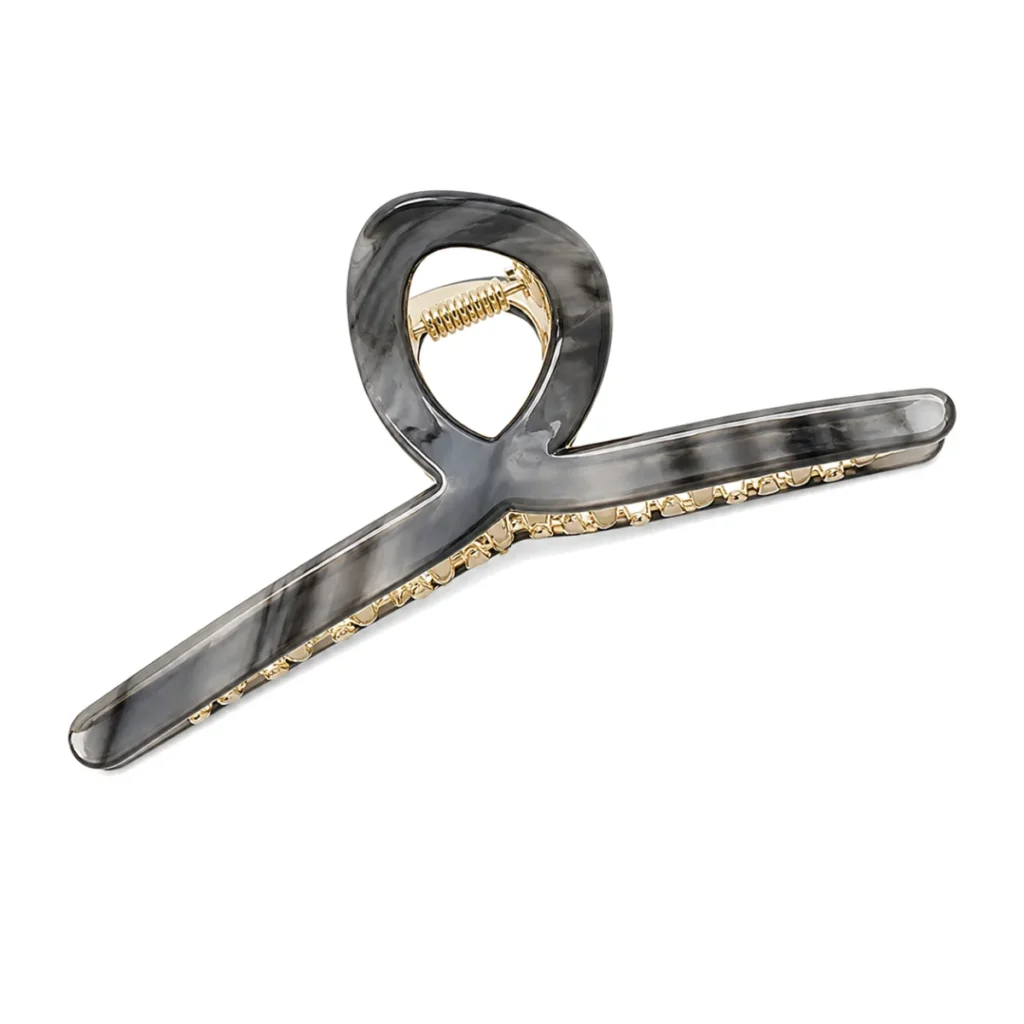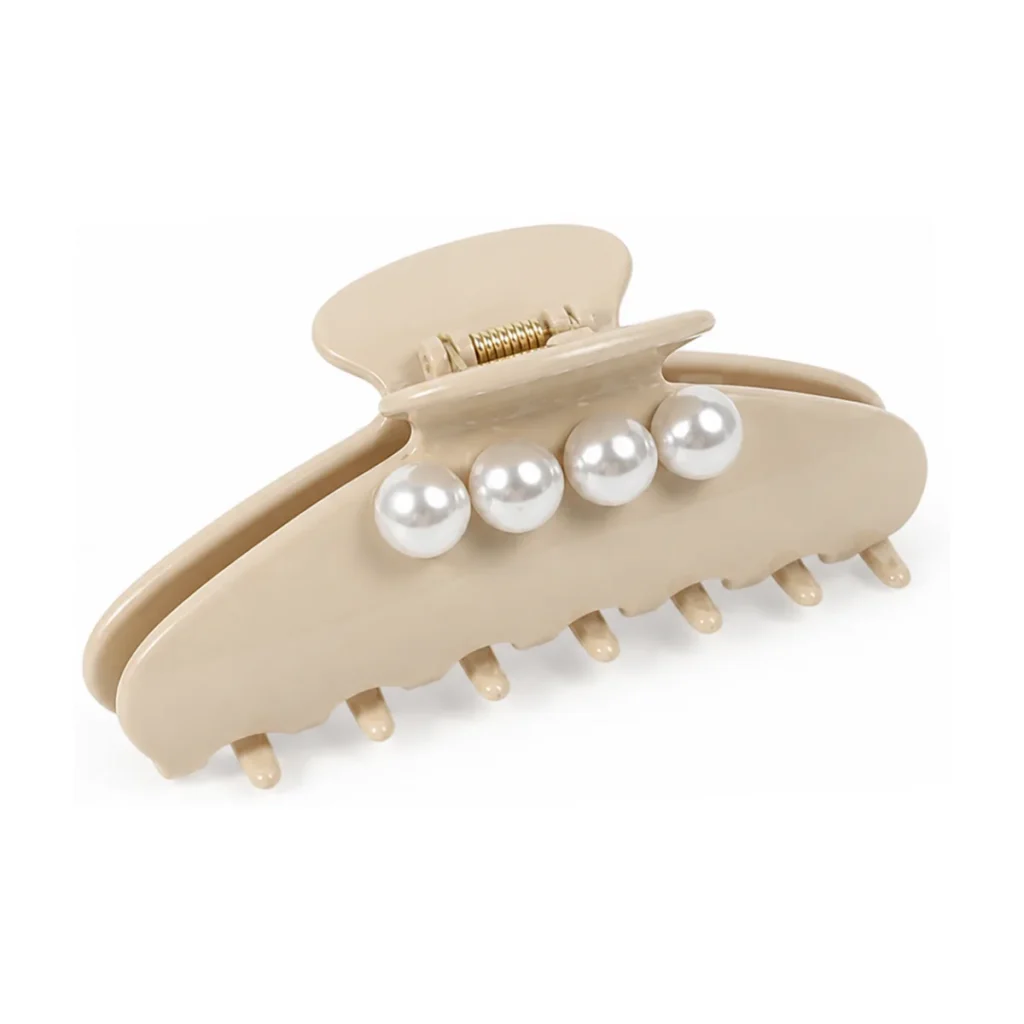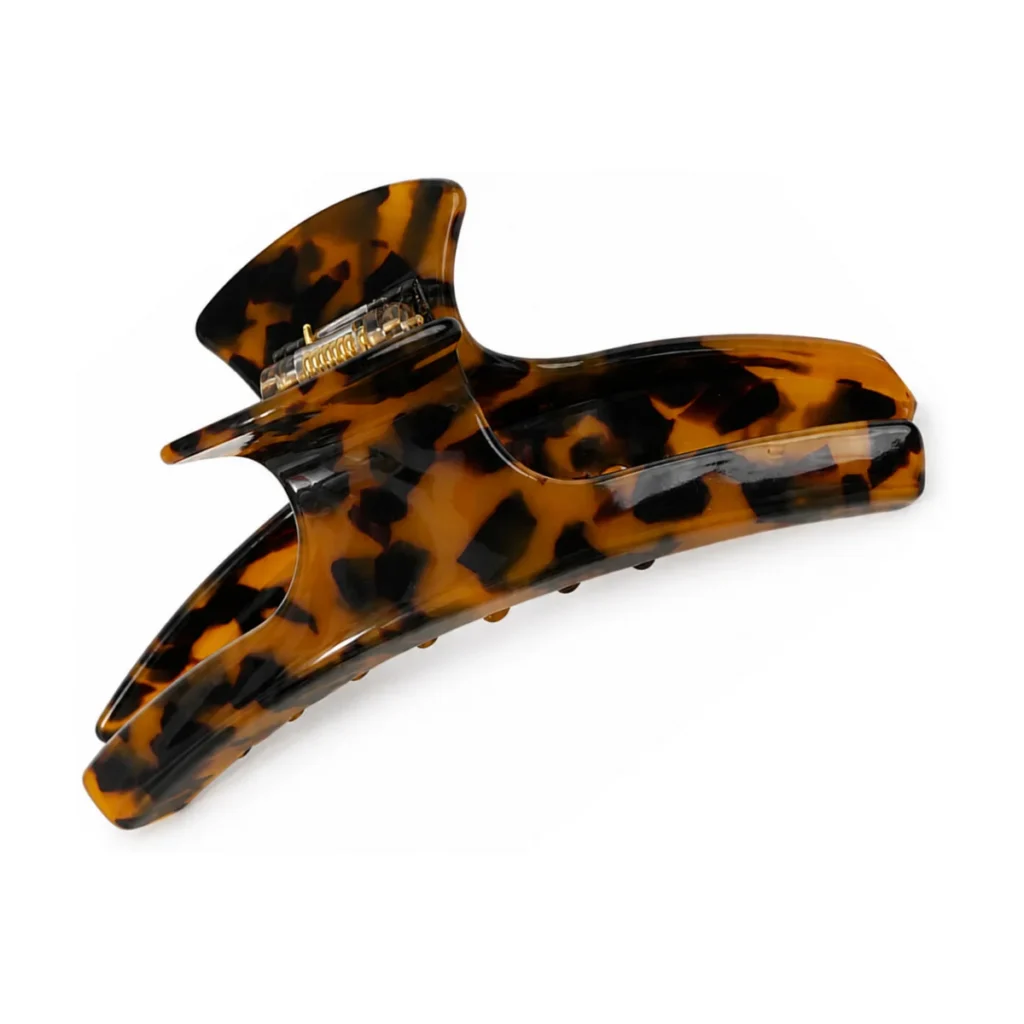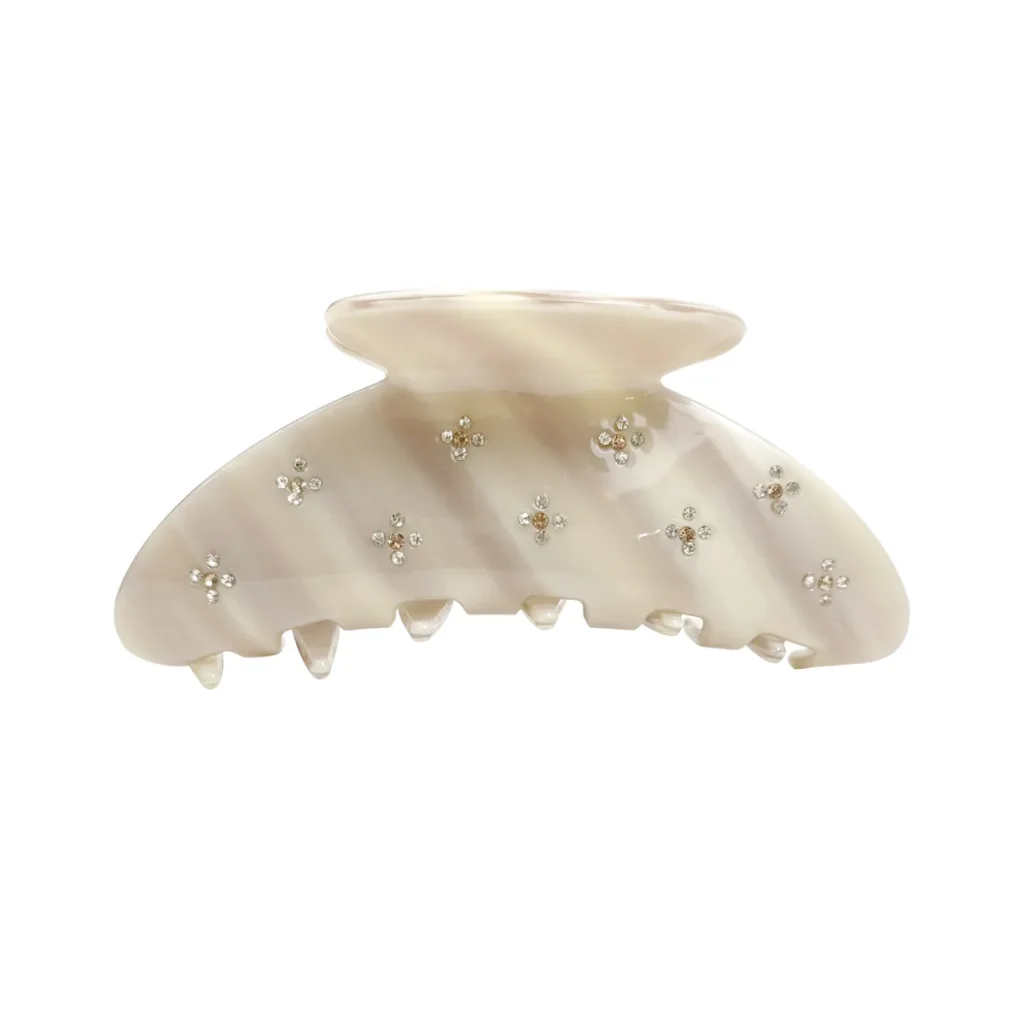
Two hair clips can look almost identical in a product photo and cost very different amounts to make. The gap is rarely the design. It is whether the part was cut out of a sheet of cellulose acetate or shot into a steel mould as ABS — and that single decision sets your tooling bill, your minimum order, how closely you can match a brand colour, and what you are allowed to print on the carton.
The same sheet-based material decision affects headbands as well as clips. For the buying questions around width, fit and a retail-ready range, see our guide to wholesale acetate headbands.
If you are specifying a claw clip range for wholesale, our buyer’s guide to custom acetate claw clips explains what to confirm before asking suppliers to quote.
This guide is written for the person specifying the material, not the person wearing the clip. If you are choosing a clip for your own hair, the short version is that acetate is the premium option and you can feel the difference in about two seconds. Everything below is about what that difference means on a purchase order.
Two Materials, Two Opposite Production Routes
Every cost, minimum and defect discussed on this page follows from one fact: acetate arrives at the factory as a solid sheet, and ABS arrives as pellets. One process removes material, the other adds it.
Cellulose Acetate: A Subtractive Process
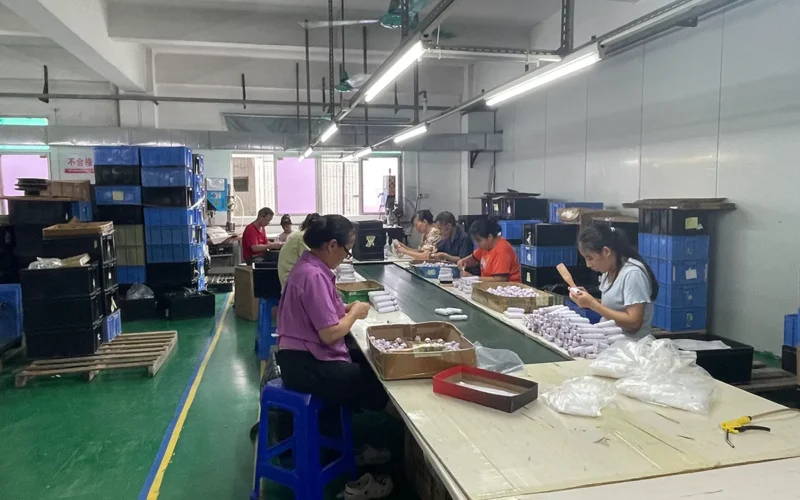
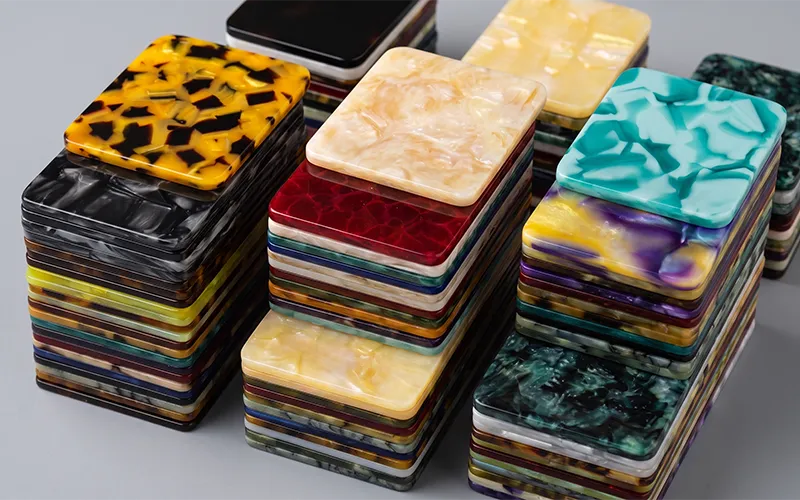
Acetate is supplied as pressed sheet or block, typically a few millimetres to just over a centimetre thick, with the colour and pattern already built into the body of the material. Making a clip means taking material away: blanks are die-cut or CNC-routed out of the sheet, edges are shaped and bevelled, and the part then goes through several stages of tumbling and hand polishing to bring the gloss up. Hardware — the spring bar, the hinge pin, the tension spring — is fitted at the end.
The polishing is the part buyers tend to underestimate. It is hands and hours, not a machine cycle, and it is where the difference between a mediocre acetate clip and a good one actually lives.
ABS: An Additive Process
ABS arrives as pellets, is melted, and is injected into a steel mould that already contains the finished geometry. The part comes out of the tool essentially complete, in seconds. Any pattern, metallic look or tortoise effect has to be applied on top afterwards by spraying, plating or hydro-dipping — which is why an ABS finish is a coating with an edge that can chip, rather than a property of the material.
| Production factor | Cellulose acetate | ABS plastic |
|---|---|---|
| Input form | Pressed sheet or block | Pellets |
| Forming method | Die-cut or CNC from sheet | Injected into a steel mould |
| Finishing | Multi-stage tumbling and hand polish | Complete out of the tool; optional spray or plating |
| Handling time per piece | Minutes | Seconds |
| Where the pattern lives | Through the full thickness | On the surface |
| Offcuts and scrap | Cannot be reground into new sheet | Runners reground and re-shot |
That last row does more damage to a quotation than most buyers expect, and we come back to it below.
Tooling Is What Decides Your First Order
An injection-moulded clip needs its own steel mould, cut before the first usable sample exists. You pay for that tool up front and amortise it across the run. If you want to adjust the shape after the tool is cut, you are looking at a mould modification or a new mould — and a design change late in development is expensive rather than merely annoying. The commercial logic of moulding therefore pushes you toward few shapes and large quantities.
Acetate has no mould at all. A new shape is a new cutting die or a new CNC path, so a revision is a programming change rather than a capital expense, and sampling does not wait on tool-cutting. You can develop and sample several shapes in acetate for a fraction of what a single dedicated ABS tool costs.
This is the reason our minimums differ by material rather than by product. Acetate claw clips and hair clips start at 500 pcs per colourway; acetate combs, brushes and hair forks start at 1,000 pcs. ABS at those quantities would load the whole tooling cost onto a few hundred units, at which point the per-piece price stops resembling a plastic price at all.
| Commercial factor | Cellulose acetate | ABS plastic |
|---|---|---|
| Dedicated tooling | None — cutting die or CNC program | One steel mould per shape |
| Cost of adding a shape | Low | A further full mould |
| Design change mid-development | Re-cut the program | Mould modification or re-cut |
| Viable at low volume | Yes | Only once the tool is amortised |
| Practical starting quantity | 500 pcs clips / 1,000 pcs combs and brushes | Volume run |
| Suits seasonal or trend drops | Yes — shapes change cheaply | Poorly — each shape is a tool |
If you are launching a collection, testing several silhouettes, or running seasonal drops, this is usually the section that settles the question.
Where the Unit Cost Actually Goes
Acetate cost sits in three places. The sheet itself is more expensive than pellets. The labour is real, because polishing cannot be automated away. And the yield matters: the material between nested blanks on a sheet is scrap, and unlike a thermoplastic runner it cannot be melted and re-pressed into new sheet. You pay for the offcut and then throw it away, so how efficiently your shape nests on the sheet is a genuine line in the quotation. A wide, sprawling silhouette can cost noticeably more than a compact one of the same weight.
ABS cost sits somewhere else entirely. Pellets are cheap, the cycle is seconds, and runners go straight back into the hopper. What you are really paying for is amortised tooling plus secondary finishing — and spraying or plating is both where ABS quotes get expensive and where the product gets fragile, because a coating chips at edges and a bare material does not.
One item that rarely reaches the spreadsheet: acetate is denser than ABS, roughly 1.3 against 1.05 g/cm³, so the same clip is around a quarter heavier. On air freight, which is priced by weight, that is a real cost. On sea freight it disappears into the container.
The shape of the two cost curves is what matters. Acetate cost per piece stays fairly flat as quantity rises, because it is mostly material and labour. ABS cost per piece falls steeply until the mould is paid off, then flattens out below acetate. There is a crossover quantity, and it is specific to your shape and your volume — so ask for both quotes at the quantity you actually intend to buy, rather than assuming plastic is cheaper because plastic is usually cheaper.
Colour Development Works in Opposite Directions
With ABS you specify a Pantone reference and the moulder matches it with masterbatch. The result is exact, flat and repeatable batch after batch. If your brand guidelines lock you to a specific colour, ABS will hit it.
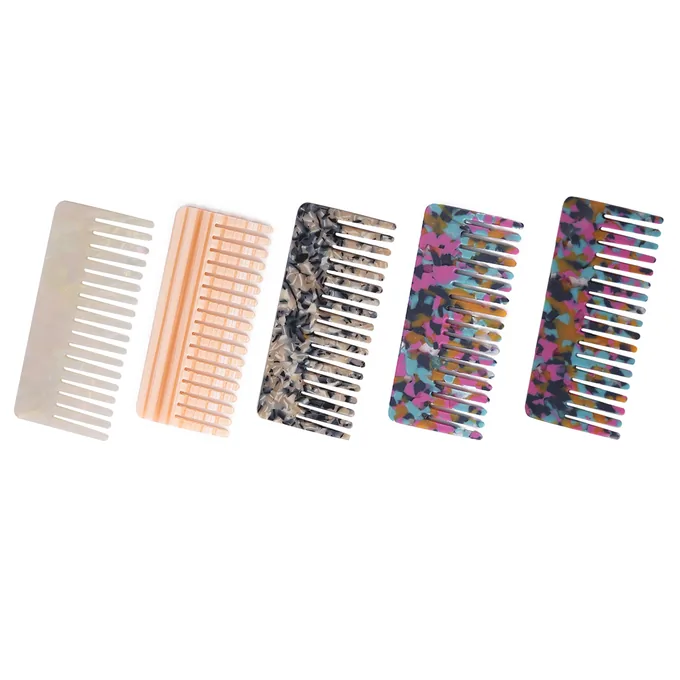
Acetate does not work that way. You are choosing from sheet that a mill has already laid up — tortoise, horn, marble, pearl, translucent, solid. The library is large, but it is a library: a genuinely bespoke sheet carries its own minimum from the sheet maker, far above the clip minimum, so custom sheet development only makes sense at collection scale. For most projects the right move is to select from existing sheet and design the shape around it. You can see the range of patterns we hold on the cellulose acetate collection page — the three families that carry a full range are tortoiseshell, pearl and marble, and each of those pages shows the same sheet cut into a dozen different shapes.
The consequence people underestimate is variation. Because the pattern runs through the sheet, no two pieces are the same, and pieces cut from different sheet lots vary more than pieces from one lot. You cannot promise a customer that the clip in the photograph is the clip in the box.
That is either a selling point or a returns queue, depending entirely on how you write the listing. Brands that merchandise it — each piece is cut from patterned sheet, so no two are alike — turn it into a reason to buy. Brands that photograph one perfect piece and say nothing get complaints. Pearlescent sheet is the clearest example, because the mica settles differently in every pour — see the pearl barrette page for how we word it. Two practical safeguards: state the variation in the product copy, and sign off reference samples showing the acceptable extremes of the range rather than one ideal piece.
The Two Materials Fail Differently, So Inspect Them Differently
A generic inspection clause means very little across two materials whose defects have nothing in common. Name the ones that apply.
On acetate, look for:
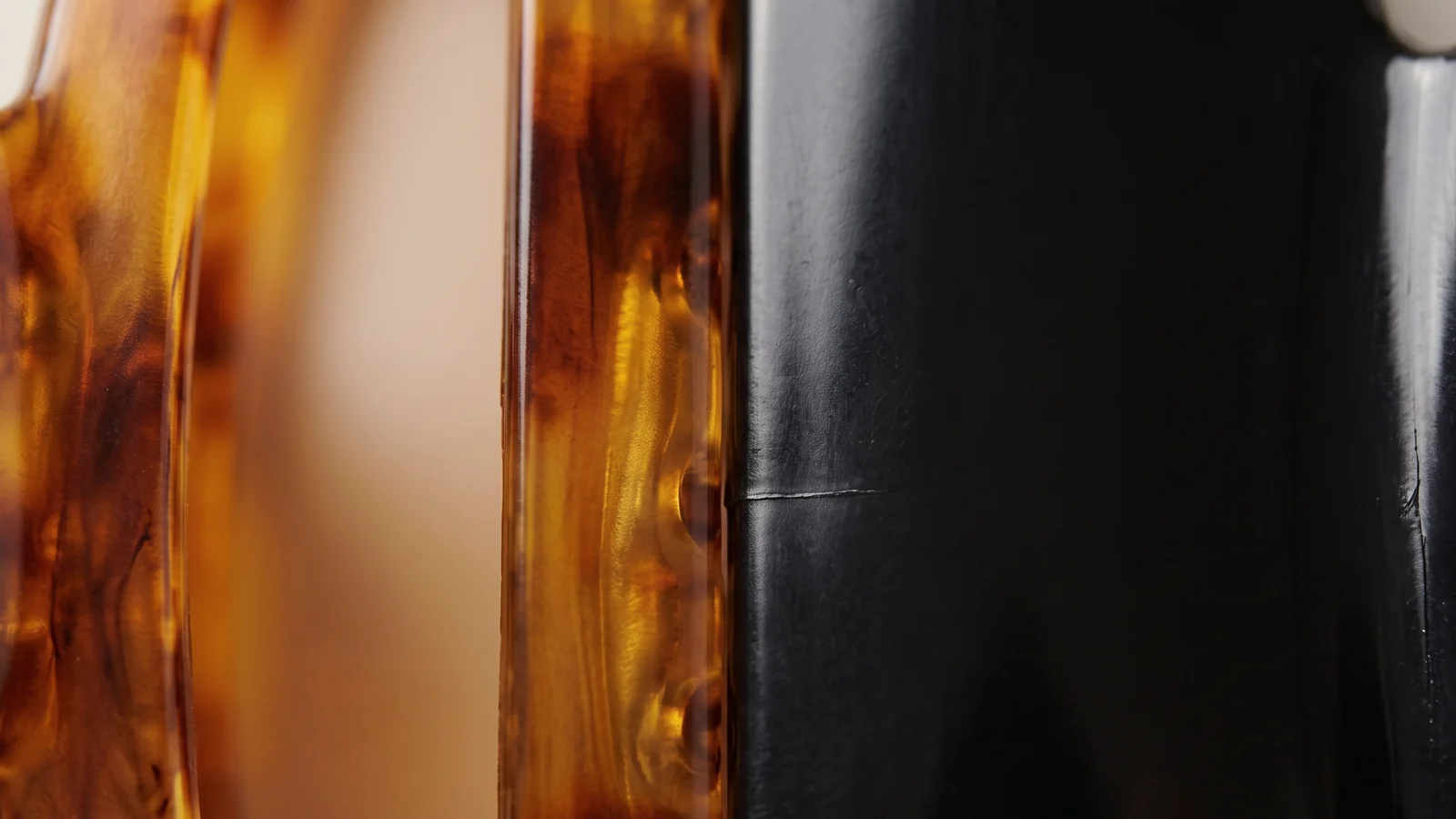
- Polish haze or dull patches — a rushed or skipped polishing stage, most visible on dark tortoise.
- Edge chipping and white stress marks — introduced during cutting, usually at tight internal corners.
- Pattern placement — a strong tortoise figure landing awkwardly on the visible face of the shape.
- Lot-to-lot pattern drift — check across cartons, not within one.
- Thickness variance — sheet is not perfectly uniform, and it shows up as inconsistent spring tension.
- Hardware corrosion — specify stainless or nickel-plated steel for spring bars. A raw steel bar is the single most common long-term failure and it eventually stains hair.
On ABS, look for:
- Mould seams, flash and gate marks — cosmetic, but they read as cheap on a product held near the face.
- Sink marks and short shots — on thicker sections and where wall thickness changes abruptly.
- Coating chip at edges — the main failure mode of sprayed and plated finishes; test it on samples before approving.
- Brittle fracture — at the hinge on a barrette, or at the teeth on a claw clip. Ask for a cycle-open test result, not a visual check.
- Colour drift between batches — happens when masterbatch is re-sourced mid-programme.
What You Can Actually Claim on the Packaging
Cellulose acetate is made from cellulose derived from wood pulp or cotton linters, which makes it plant-based and renewable in origin, and FSC-certified pulp is available on request. What it is not is a licence to print “biodegradable”. Cellulose acetate needs industrial conditions to break down in any useful timeframe; it does not disappear in a home compost bin, in soil, or in seawater. Plasticiser content also varies between grades, which affects both the environmental story and the mechanical behaviour.
ABS is petroleum-derived, technically recyclable, and available in post-consumer recycled grades that can be certified under GRS if recycled content is part of your positioning.
Both the FTC Green Guides in the United States and the tightening EU rules on environmental claims treat unqualified terms like “biodegradable”, “compostable” and “eco-friendly” as claims you must be able to substantiate. The safe framing for acetate is a statement of material origin rather than an end-of-life promise: plant-based cellulose acetate, from FSC-certified pulp. Get the grade documentation from your supplier before any of it goes to print — ours is listed on our certifications page.
Choosing by Position, Not by Preference
| Your situation | Material | Reason |
|---|---|---|
| First run, independent or DTC brand | Acetate | No tooling to fund; 500 pcs is viable |
| Premium retail, gifting, salon channel | Acetate | Weight and depth of pattern support the price |
| Several shapes, seasonal drops | Acetate | Shape changes cost a program, not a tool |
| Mass retail at a tight price point | ABS | Tooling amortises; seconds per part |
| Exact brand colour match required | ABS | Pantone masterbatch is repeatable |
| Promotional items and multipacks | ABS | Lowest landed cost per unit |
| Tiered assortment | Both | Acetate as the hero, ABS at the entry price |
For a growing brand the answer is usually not one material. It is acetate on the pieces that appear in the campaign photograph and get handled in the shop, and ABS on the multipacks. Acetate carries the brand; ABS carries the volume.
Frequently Asked Questions
Is there really no tooling cost for acetate hair clips?
There is no steel mould. Depending on the shape there may be a modest charge for a cutting die or CNC setup, but it is a different order of magnitude from an injection tool, and it does not need to be recovered over thousands of units before the price makes sense.
What is the minimum order for acetate versus ABS?
Our acetate clips and claw clips start at 500 pcs per colourway, and acetate combs, brushes and hair forks at 1,000 pcs. ABS minimums are driven by the tooling rather than by us — the quantity has to be large enough for the mould cost to disappear into the unit price, which in practice means a volume run.
Can you match my exact Pantone in acetate?
For solid colours we can usually get very close from existing sheet. For an exact match, or for a bespoke pattern, the sheet has to be made to order and that carries a much higher minimum from the sheet mill. If precise colour matching is non-negotiable and volumes are moderate, ABS is the more honest answer.
Will every piece in my order look the same?
In ABS, yes. In patterned acetate, no — and it cannot be made to. Approve reference samples that show the range you accept rather than one ideal piece, and describe the variation in your product copy so it reads as craft rather than as inconsistency.
Can I put both materials in one order?
Yes, and tiered assortments often should. The two materials run on different lines with different lead times, so tell your supplier at quotation stage rather than after the acetate is already cut, and expect the shipment to be gated by whichever line finishes last.
How do I verify that I received acetate and not plastic?
Keep a signed reference sample and weigh incoming goods against it — acetate is about a quarter denser, so a substituted ABS part shows up on a scale immediately. Beyond that: hold a piece to a light and look for depth through the thickness rather than colour sitting on the surface, and check a cut edge, where a coated ABS part reveals a different colour underneath. Both checks take seconds and are worth writing into your incoming inspection.
Does acetate cost more to ship?
By air, yes — roughly in proportion to the weight difference. By sea it is immaterial, because you will hit the volume limit of the container long before the weight limit.
The Short Version
Acetate is the material to specify when you are launching, when you are testing shapes, when quantities are moderate, and when the product has to justify a premium price in the hand. ABS is the material to specify when the shape is settled, the volume is large, the price point is tight, and the colour has to be exact. The mistake is deciding on reputation instead of on your own numbers — get both quoted at your real quantity and the crossover point will tell you which one you are actually buying.
If you want to go deeper on how the materials behave across formats, our materials guide covers acetate alongside beech, bamboo and sandalwood. For the wider sourcing picture, see how to source hair accessories from China, and for one product category in detail, what is a French barrette.
Working out which material fits your programme? Send us the shape, the quantity and the price point you need to hit, and we will quote both so you can see the crossover for yourself. Get a quote — we reply within 24 hours, and samples are available in both materials.
Acetate Claw Clips We Make