A paddle brush for thick hair needs more than a large head. Its pins must enter a dense section without folding away, the cushion must transfer enough pressure without feeling rigid, and the tips must stay smooth against the scalp. If one part is wrong, a brush that looks substantial in a product photo may skim the surface, catch strands or become tiring to use.
For many thick-hair projects, rounded steel pins are the practical starting point. They are harder than nylon and can pass into dense hair with less deflection. That does not make every steel-pin brush suitable: tip finishing, cushion movement, spacing and overall size still need to be approved as one system.
This guide is for brand and retail buyers specifying a custom paddle or cushion brush. It focuses on the decisions that should be settled before a sample is approved, using a recent sampling revision as the central example.
The Short Answer: Start With Penetration, Then Tune Comfort
Thick hair exposes weaknesses that are less obvious on fine or low-density hair. Flexible pins may bend before they reach the inner section. A soft cushion may absorb too much of the brushing force. A wide brush can cover more hair, but width does not help if the active pin field cannot move through the section.
- Define the target hair density and whether the brush is for dry detangling, smoothing or scalp contact.
- Select the pin system for reach and release.
- Tune the cushion hardness and size around that pin system.
- Approve the body, finish, logo and packaging after the working construction feels right.
Our broader guide to hair brush bristle and pin types compares nylon, boar, mixed, steel and wooden systems. Here, the question is narrower: what should a buyer specify when thick hair is the main use case?
A Real Sampling Revision: Nylon Ball Tips to Steel Pins
In one custom project for a thick-hair customer, the first sample used nylon ball-tip pins. The idea was reasonable: nylon is familiar, flexible and common in detangling brushes. In use, however, the customer found that the pins could catch the hair instead of entering and releasing cleanly.
The revised sample changed the working pin field to steel. The harder pins entered the dense section more easily and did not produce the same snagging problem in the customer’s test. The lesson was not that nylon is defective. This particular nylon construction was too soft for the hair density and experience the buyer wanted.
This project detail is anonymised to protect the customer. It is one development case, not a universal laboratory result. A buyer should still test the proposed construction on the target hair type before bulk approval.
What to Specify in a Thick-Hair Brush Brief
Do not send a supplier only a mood board and the words “large paddle brush.” The working specification should separate the parts that determine performance.
| Decision | What the buyer should state | Why it matters for thick hair | What to check on the sample |
|---|---|---|---|
| Primary job | Dry detangling, smoothing, scalp contact or another defined task | Each task needs a different balance of reach, flex and surface contact | Test the exact task, not only how the brush feels in the hand |
| Pin material | Steel, nylon or another agreed system | Steel stays firm under load; nylon flex varies by construction | Does the pin field enter the section and release without catching? |
| Tip finish | Rounded and smooth contact points | A firm pin with a poor tip can feel sharp | Inspect every area under side light and move slowly through the test section |
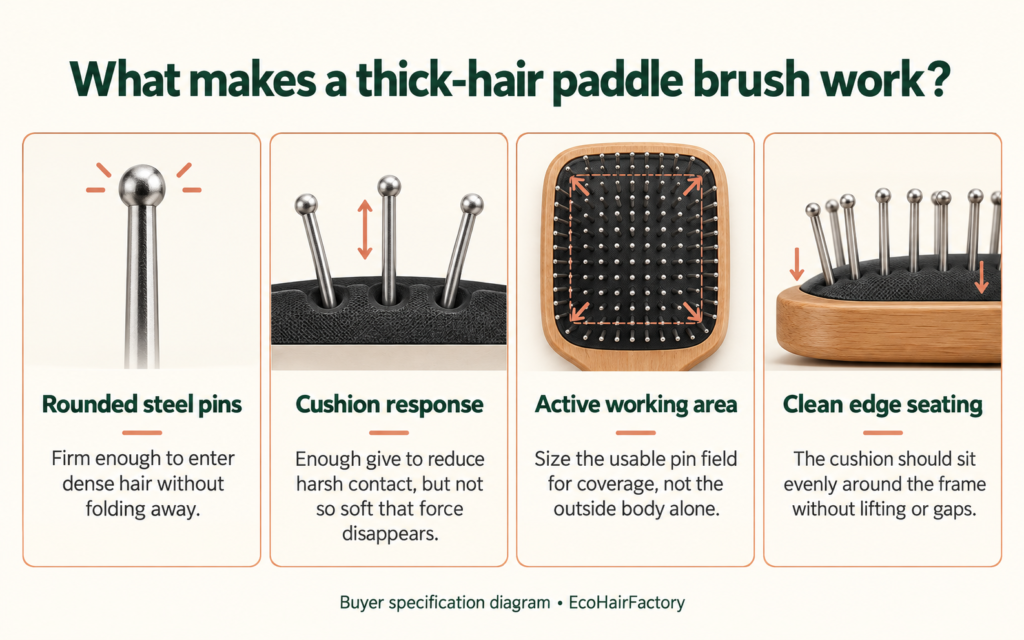
| Cushion hardness | Soft, medium or firm reference confirmed by sample | Too soft can absorb force; too firm can feel harsh | Press the centre and perimeter, then compare scalp feel during use |
| Cushion size | Matched to the brush dimensions and working area | The active field, not the outer body alone, determines coverage | Confirm the useful pin area and edge seating |
| Body size and shape | Target dimensions or an approved reference | A larger head changes handling, coverage, weight and packaging | Use it on the intended hair length and in the intended retail pack |
| Logo method | Process, colour, size and placement | A logo can fail if the process is uneven or the position wears quickly | Review the mark in normal light and after handling and cleaning |
Pin length, spacing and cushion geometry also influence the result, but they should be confirmed against an actual sample rather than guessed from a catalogue image. If there is no verified source for a number, make it a sampling decision instead of placing an invented tolerance in the RFQ.
Steel Pins Solve One Problem, Not the Whole Brush
Steel pins are useful for thick hair because they remain firm as they meet resistance. They can reach further into a dense section where a softer nylon pin may bend away. The feeling also depends on three related details.
First, the tips must be rounded and polished. Firm penetration should not mean sharp contact. Second, the pins need secure retention in the cushion; a loose pin or poorly seated cushion is a separate quality failure. Third, the cushion needs enough movement to moderate pressure. A rigid field of metal pins and a responsive pneumatic cushion do not feel the same even when the visible pins look similar.
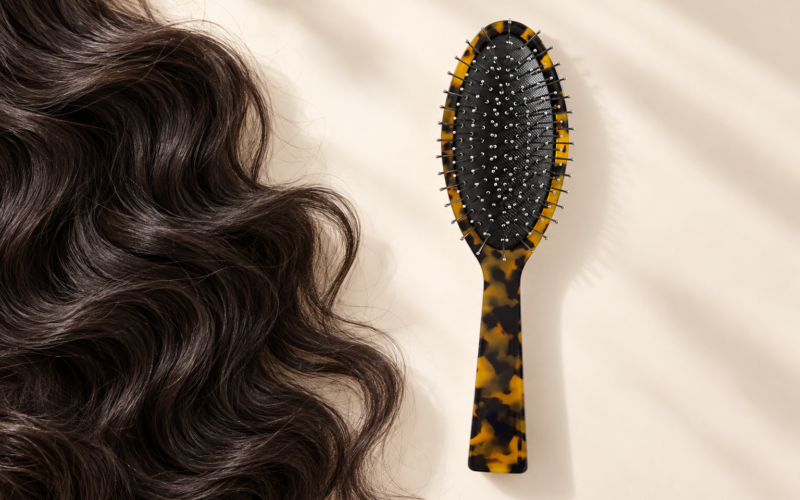
The acetate cushion hair brush with stainless-steel pins shows how an acetate body and steel-pin cushion can be combined in a private-label construction. The black oval cushion brush with steel pins shows a second body direction. These are construction references; the final pin, cushion and finish should follow the approved sample.


Cushion Hardness and Size Can Be Customised
The cushion is not a fixed component that buyers have to accept unchanged. Its hardness can be adjusted, and its size can be developed around the dimensions of the brush. This matters because the cushion controls how the pin field yields as pressure changes.
A thick-hair brief should describe the desired response in practical language. For example: the pins need to enter a dense dry section without the cushion collapsing, while the pad should still move enough to avoid a rigid scalp feel. The factory can then prepare or select a cushion direction for sampling.
Avoid approving cushion hardness by pressing it once with a thumb. The same pad can feel different after pins are fitted and the cushion is seated in the frame. Judge the assembled brush, and compare revisions with the same hair section and brushing task.
Current Sample Budget, Timing and MOQ
The following figures are current factory planning guidance for this type of development. They are sample and programme figures, not retail unit prices. The final quotation depends on the body material, construction, finish, artwork and packaging.
| Route | Approximate sample cost | Typical sample timing | MOQ guidance | Best use |
|---|---|---|---|---|
| Existing finished brush | About RMB 200 | Confirm with the selected item | Confirm with the quotation | Checking a current construction before custom development |
| Custom flat brush | About RMB 500 per style | Sometimes around 15 days | 1,000 pcs per design | A new flat profile without a pneumatic cushion |
| Custom cushion brush | About RMB 1,000–1,500 per style | About 20–30 days | 1,000 pcs per design | A custom body, cushion and pin system developed together |
Custom development is quoted by style. The custom sample fee is non-refundable and pays for developing one construction direction; it is not a per-piece selling price or a deposit against the bulk order. If the buyer asks for two different bodies or two working systems, they should be treated as separate sample directions unless the quotation says otherwise.
For a wider explanation of approvals and cost ownership, see Hair Accessory Sampling Costs and Approval. The MOQ guide explains why “1,000 pieces total” is not always the same as 1,000 pieces of one approved design.
Choose the Logo Process After the Surface Is Known
Common brush logo options include laser marking, silk screen printing, pad printing, a metal plate and engraving with colour fill. The right choice depends on the body material, surface shape, desired contrast and brand style.
Engraving with colour fill deserves extra attention during approval. The colour is filled by hand, so uneven fill is a more common reason for rework than with processes that do not require manual filling. A buyer should inspect the border, coverage and consistency of the filled area rather than approving only the artwork size on a digital proof.
Ask for the logo sample on the actual brush surface whenever possible. A logo that looks clean on a flat test piece can behave differently on a curved, grained, coated or polished body. Keep the approved logo sample with the approved working brush so production has one complete reference.
QC Should Follow the Brush, Not Stop at Appearance
The factory’s inspection covers the details of each brush, and the product is tested before shipment. For the buyer, the useful step is to turn the approved sample into a written inspection reference so that “checked” has a shared meaning.
| QC area | Practical approval point |
|---|---|
| Pin field | Correct pin system; no missing, visibly loose or damaged pins |
| Tip contact | Smooth, rounded contact across the full working area |
| Cushion | Correct response, clean seating and no lifting around the edge |
| Thick-hair use | Enters the target section and releases without the snagging seen in the rejected sample |
| Body and finish | Shape, surface and colour match the approved reference |
| Logo | Correct process, position and appearance; colour fill is even where used |
| Assembly | Handle and body feel secure during normal use |
| Packaging | The brush fits without crushing pins or loading the cushion incorrectly |
Numeric pass/fail limits should be agreed for the specific project where they are needed. They should not be copied from an unrelated brush. Record the test method, approved result and any boundary sample, then use the same reference during production inspection.
A Concise RFQ for a Custom Paddle Brush
- Target hair type, especially density, texture and intended dry or wet use
- One primary job for the brush
- Preferred body material, shape and target size
- Steel, nylon or another pin direction, with a reference if available
- Desired cushion response and active cushion size
- Logo process, artwork, colour and placement
- Packaging format and destination market
- Order quantity by design
- Required sample date and target bulk delivery window
- The use test and visible QC points that will decide approval
That brief gives the factory enough information to recommend a construction without pretending every measurement is already solved. To discuss a thick-hair brush programme, send the brief through the contact page and identify whether you want to begin from an existing construction or a fully custom style.
Frequently Asked Questions
Are steel pins always better than nylon for thick hair?
No. Steel pins are firmer and can enter dense hair more easily, which solved the snagging problem in the sampling case described here. Nylon quality, diameter, exposed length, spacing and cushion design all affect performance. Approve the complete construction on the target hair type.
Can the hardness of a paddle-brush cushion be customised?
Yes. Cushion hardness and cushion size can be adjusted to suit the brush dimensions and intended response. Test the assembled sample because pins, cushion seating and body geometry change the final feel.
How much does a custom paddle-brush sample cost?
Current planning guidance is about RMB 500 for a custom flat brush and roughly RMB 1,000–1,500 for a custom cushion brush. An existing finished brush sample may be around RMB 200. Confirm the current amount for the selected construction and artwork.
How long does a custom cushion-brush sample take?
A custom cushion brush usually needs about 20–30 days in the current workflow. A flat brush can sometimes be sampled in around 15 days. Material availability, construction and logo work can change the schedule.
What is the MOQ for a custom brush design?
The current guidance for these custom brush programmes is 1,000 pieces per design. Confirm how colourways, artwork and packaging are counted in the quotation before dividing the order.
Which logo method is least likely to need rework?
There is no single method for every surface. Laser, silk screen, pad printing, metal plates and engraving with colour fill each suit different materials and finishes. Engraved colour fill needs particularly careful approval because hand filling can be uneven.