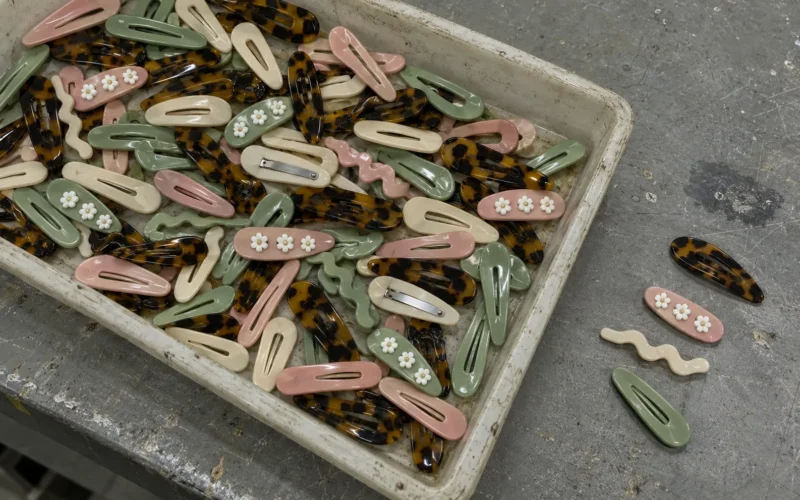
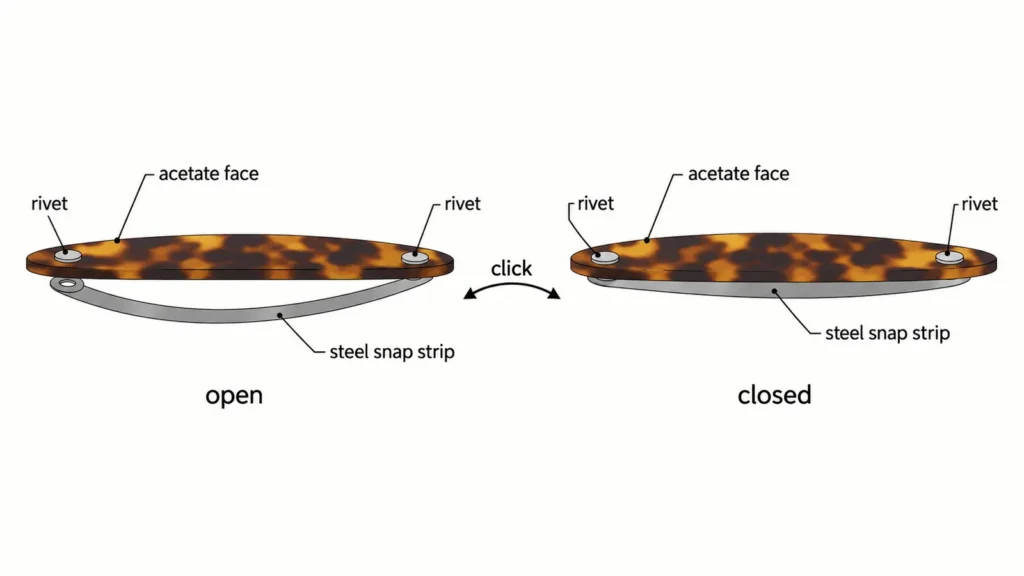
A snap hair clip is the small, flat clip that closes with a click. There is no hinge, no teeth and no coil spring: the whole mechanism is one curved strip of steel that flips between two stable positions, open and shut. Put a decorative face on top of that strip and you have one of the cheapest clips to make and one of the most common to see fail.
For a brand, that makes snap clips a deceptively simple product. Two samples can look identical in a photograph and behave completely differently a month into use, and the difference is almost always in parts a buyer does not think to ask about. This guide covers how the mechanism works, the three things on the face that move the price, how snap clips actually sell, and what to put in a brief so the quotation you get back is one you can compare.
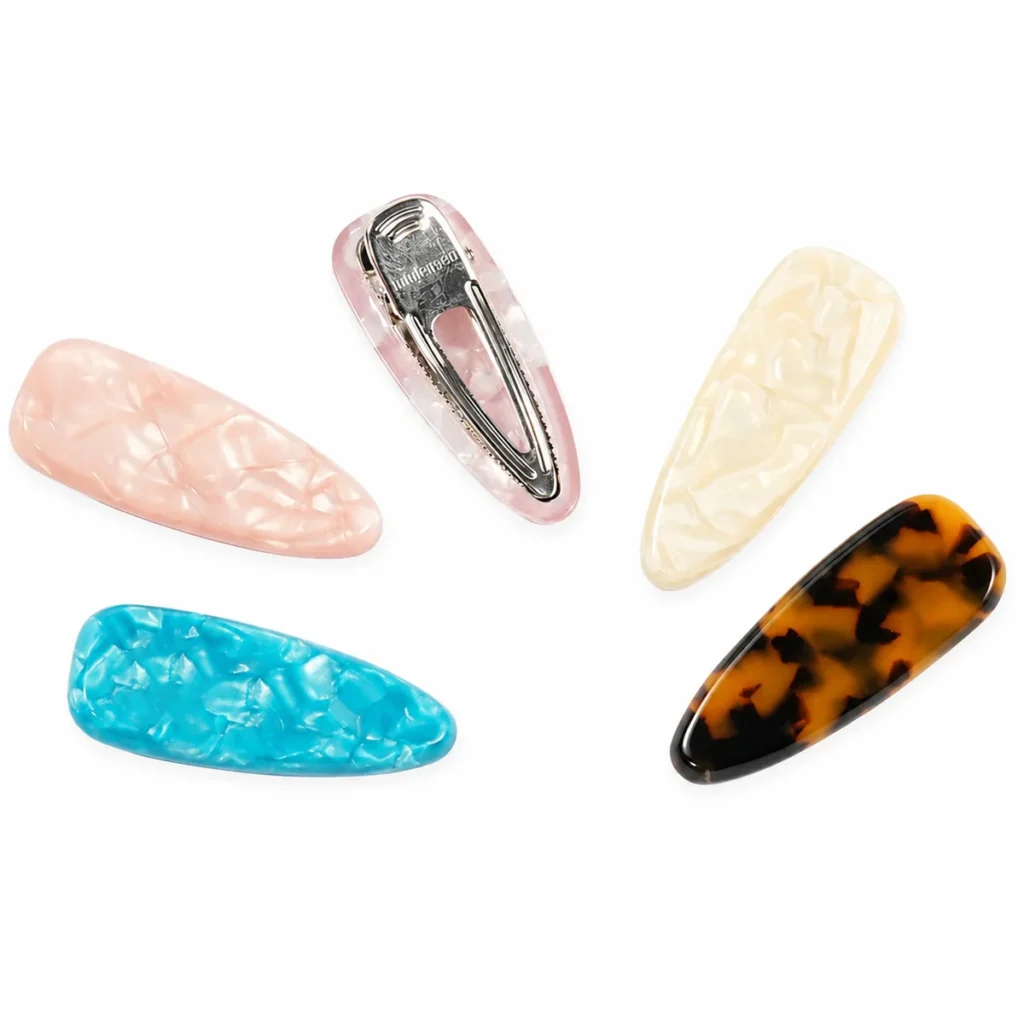
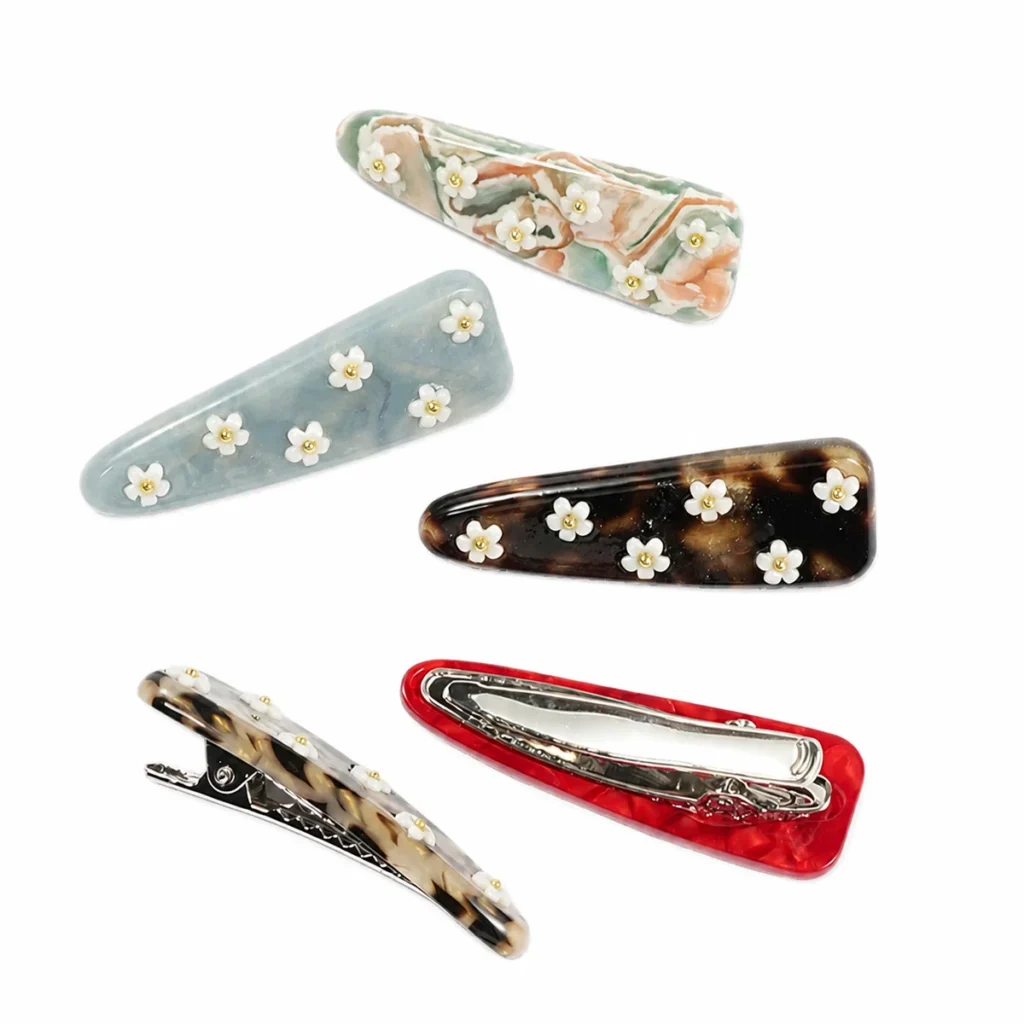
What a Snap Clip Is, and What It Is Not
The strip under a snap clip is pressed with a slight curve. Push on it and the curve inverts with a click; push the other way and it flips back. Hair is held between the strip and the underside of the face in the closed position. Nothing else is doing any work, which is why the strip matters more than anything you can see from the front.
That mechanism decides where a snap clip belongs in a range. It is a clip for a fringe, a small twist or a section pulled back from the face, and it is usually worn in twos or threes rather than on its own. It is not built to carry weight: a French barrette of the same length clamps a much heavier section, and a duckbill clip spreads its grip along a long flat jaw. If the product brief says “holds thick hair all day”, a snap clip is the wrong starting point, whatever the face looks like.
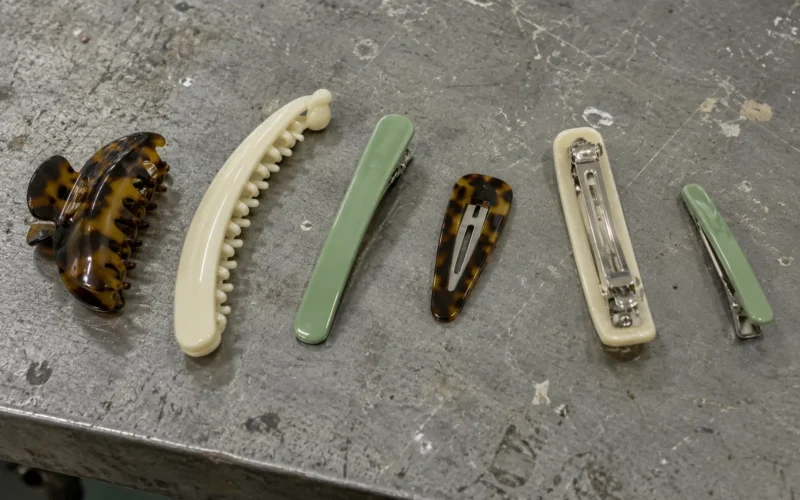
Names cause the usual trouble. Snap clips also get called tic-tac clips, click clips and, occasionally, barrettes. If you are briefing a factory, describe the mechanism rather than trusting the name, and if you are weighing snap clips against sprung-jaw styles, our guide to duckbill clips sets the families side by side. The complete range, seven kinds and which to stock, is in types of hair clips.
The Bar Is the Product
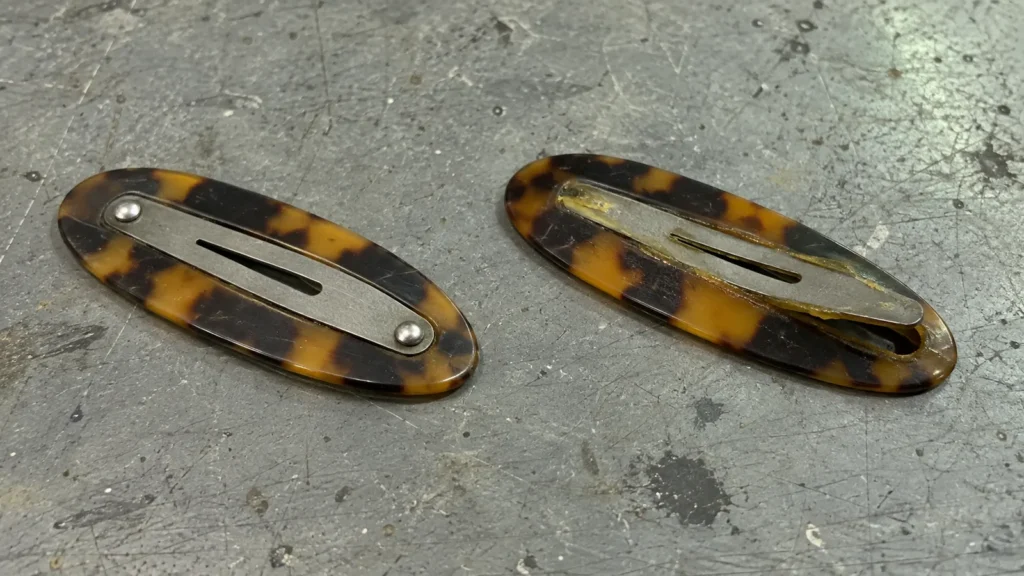
The first question to ask about any snap clip sample is how the face is fixed to the bar. There are two answers, and only one of them survives a bathroom.
A riveted bar goes through the acetate, so the joint is as strong as the sheet itself. A glued bar is as strong as the adhesive, and adhesive is exactly what heat, steam and hair products attack. A glued bar is the single most common failure on a cheap snap clip: the face lifts at one end, then the clip rattles, then the face comes away in the customer’s hand. Riveting is slower, and it is the only way we fix a snap bar.
The second question is tension, which is a separate specification from the shape and is almost never written into a brief. Fine hair wants a softer bar than thick hair. A factory that is not told the hair type will ship the middle setting, and the middle setting suits neither end of the range. If you tell us who the clip is for at enquiry, we set the tension to suit instead.
| Check on the sample | What you want to see | What it tells you if you don’t |
|---|---|---|
| How the bar is fixed | Rivets visible through the face or on the reverse | A glue line means the joint depends on adhesive |
| Click action | A clean click in both directions, no dead spot | A soft or partial flip means the strip is under- or over-formed |
| Tension | Set for the hair type named in the brief | A default setting nobody chose |
| Face at the ends | Sits flat on the bar along its whole length | A lifted end is the first sign of a failing joint |
The Face: Thickness, Edge and Pattern
Once the bar is right, three things about the face account for most of the difference between a clip that looks like a product and one that looks like a giveaway.
Sheet thickness
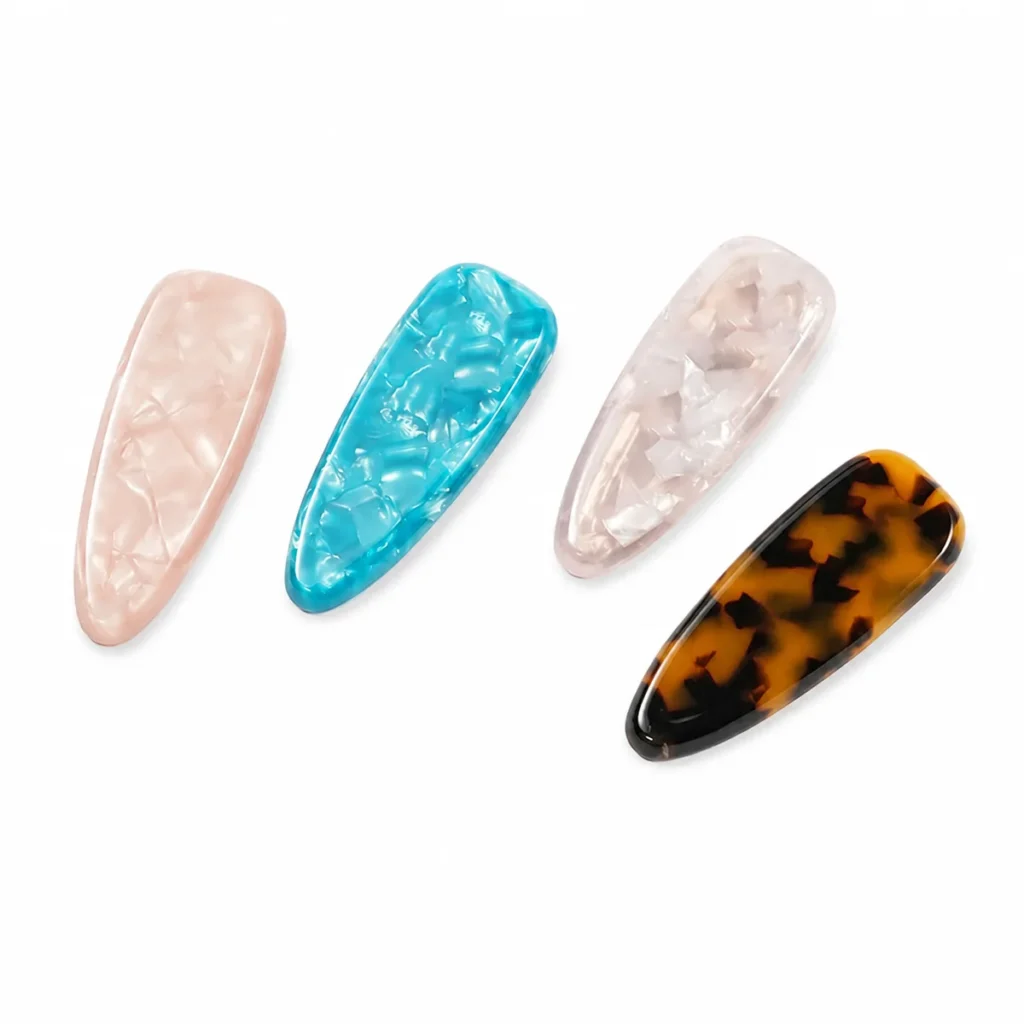
A shaped face needs depth to hold its shape. Our teardrop snap clip is cut from 3 mm acetate because a domed teardrop cut from thin sheet reads as a flat oval and loses the point of the design. Thicker sheet costs more per piece and yields fewer pieces per sheet, so it is a real line on the quotation, not a rounding error.
The edge
A rounded edge can be moulded or polished. Moulding is faster, and it leaves a seam running round the widest part of the piece. On a patterned sheet you might not notice it. On a plain colour it is the first thing you see, and on a clip this small there is nowhere for it to hide.
The pattern
Tortoiseshell is the colourway that sells snap clips year-round, and it is where cheap versions are easiest to spot. In cast acetate the figuring runs right through the sheet, so a chipped edge shows the same pattern as the face. A printed pattern sits on the surface and shows a pale core the moment it is scratched. The wider material argument is in acetate hair clips versus plastic; for a snap clip the practical test is simply to look at the edge.
Placement matters too. On a 5.5 cm teardrop we cut the tortoiseshell so the dark figuring runs the length of the drop rather than across it, which is what makes a small piece read as shell rather than print. That kind of instruction belongs in a brief, because it changes how pieces are nested on the sheet.
Shape: Why Cut Beats Bent
Shaped snap clips are where the gap between a good sample and a cheap one gets widest, because there are shortcuts that look fine from the front.
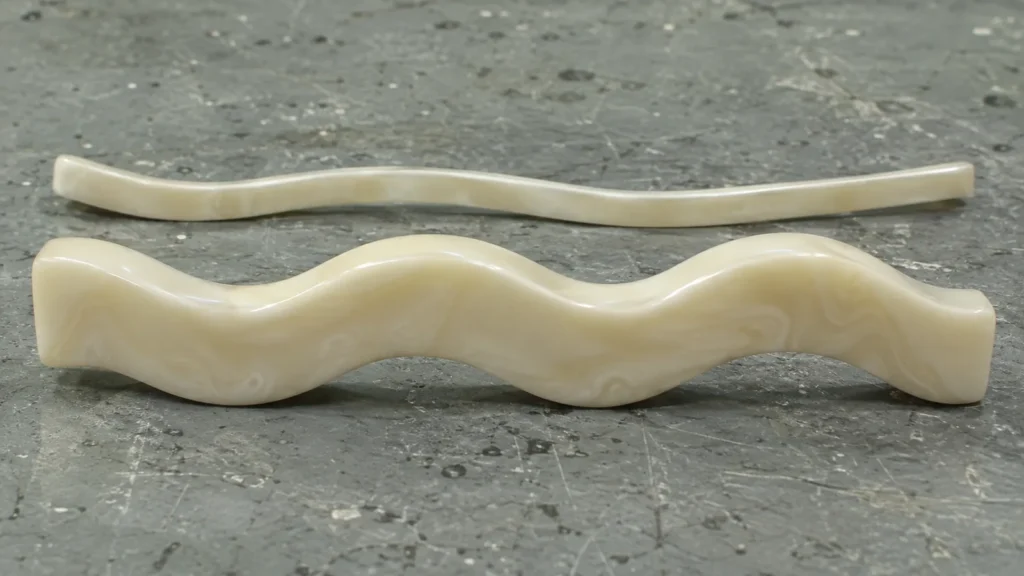
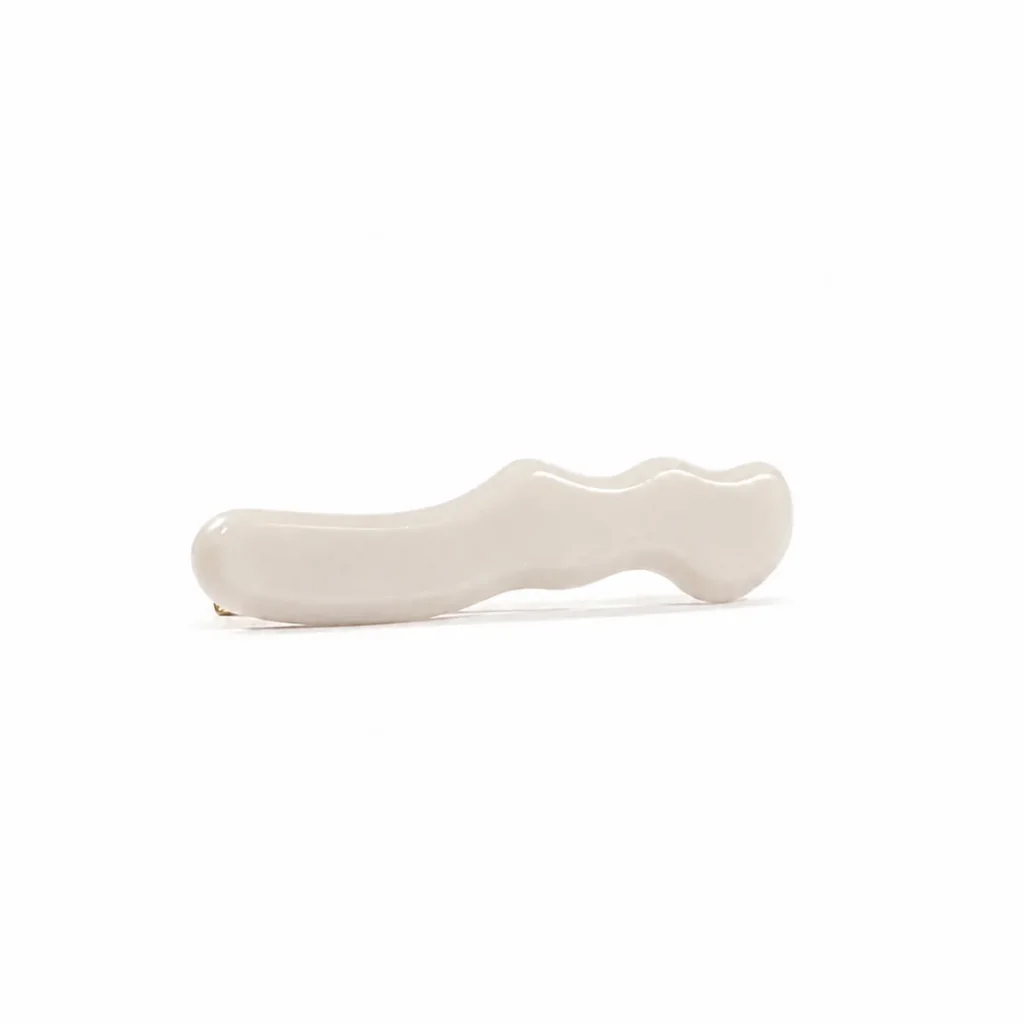
Take the wavy or squiggle clip. The ripple on ours runs through the full 1.5 cm depth, so the side edge follows the same curve as the face. That only happens if the wave is cut from solid block. Bend a flat strip instead and you get a wave from the front and a flat edge from the side, which is obvious the moment the clip is worn at an angle. Cutting costs more because the offcut between the peaks is waste, and that is the honest reason a properly cut wavy clip does not price like a bent one.
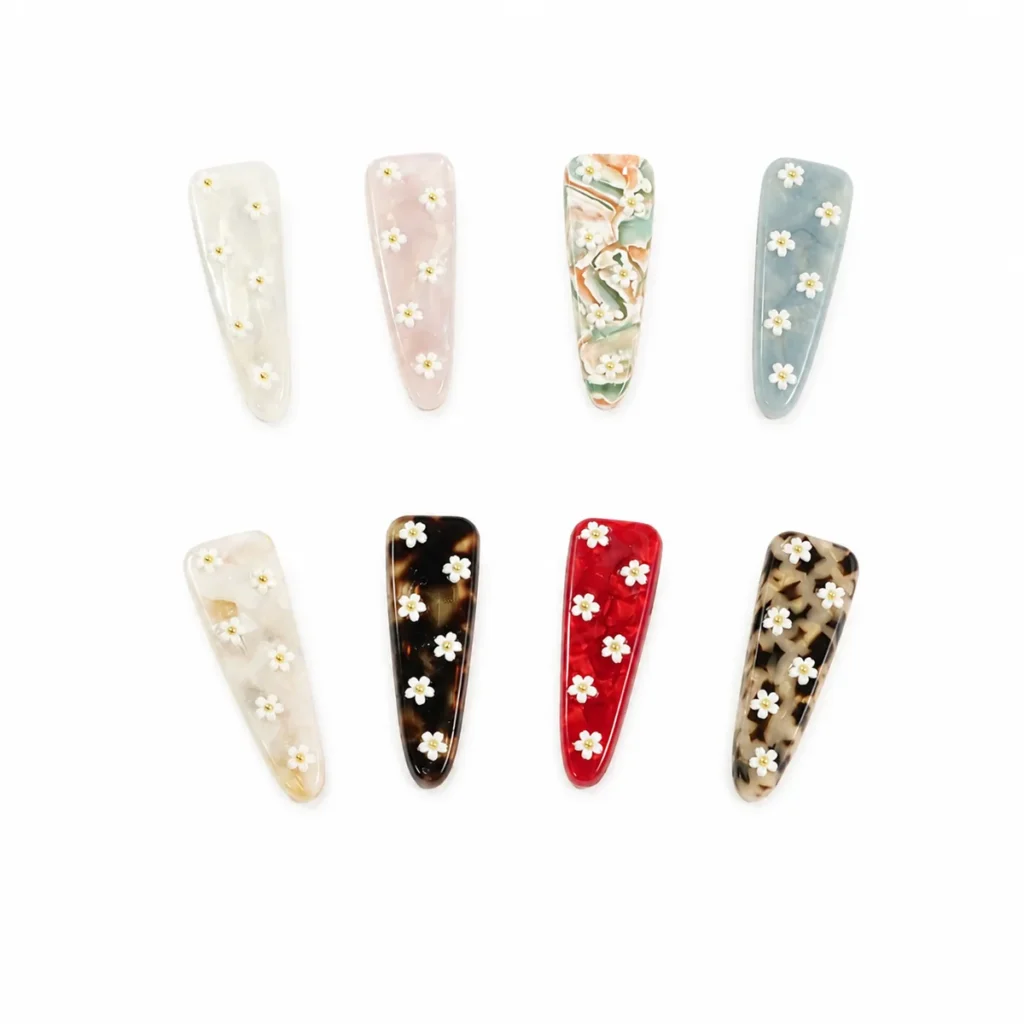
Applied decoration has the same split. Flowers glued on top of a face leave an adhesive line round each base and tend to rotate over time. On our daisy snap clip each flower is acetate, set into a shallow recess routed into the face before polishing, so it sits flush and cannot turn. Keeping the flowers in the same material as the body also means the clip can be handled as one material at end of life, which matters to exactly the customer who bought it for the material.
Size, and How Snap Clips Actually Sell
Most snap clips are small, and the size decides how they are merchandised. At 5.5 to 7 cm they are worn in pairs or threes, which changes what you should order. On our teardrop clip the solid colours are supplied in pairs, because solids are the ones customers wear symmetrically; the figured colourways sell as singles because no two pieces of figured acetate match anyway. The daisy clip usually goes out on a card of three or five.
| Snap clip | Size | Weight | Stock colourways | Longer version |
|---|---|---|---|---|
| Teardrop | 5.5 × 2.2 × 1.5 cm | 8 g | 7 | 7 cm and 9 cm |
| Daisy | 5.6 × 1.9 × 1.5 cm | 7 g | 8 | — |
| Wavy | 6.8 × 1.5 × 1.5 cm | 6 g | 9 | 8.5 cm |
The longer versions in the table run on cutting profiles we already have, so a size ladder in one shape is a cheaper way to widen a range than three unrelated shapes. The wavy clip at 8.5 cm holds noticeably more hair than the 6.8 cm volume size, which is worth knowing if your customers have asked for “the same, but it stays in”.
If the clips will be sold on cards, quote the card with the clip rather than after it. Card size drives the polybag size, and the polybag drives how many units fit a carton, so a card decided late can quietly change the landed cost. The trade-offs are laid out in our note on packaging minimums and cost.
Branding on a Very Small Clip
A 5.5 cm face leaves very little room for a mark, so decide early whether the brand lives on the clip or on the packaging. On the clip, the options are recessed ink-fill, hot foil stamping or laser engraving. Off the clip, a custom backing card and polybag carry the name without competing with the pattern. Many ranges use both: a small mark on the reverse and the full brand on the card.
Minimums and Lead Times
Our minimum for acetate snap clips is 500 pieces per design, and each colourway counts as a design. A teardrop clip in all seven stock colourways is therefore seven designs and 3,500 pieces, not 500 split seven ways. The reasoning behind that rule is set out in MOQ explained, and it is the number to plan a launch around before you fall in love with a full colour card.
Samples take 15 to 20 working days and bulk production 25 to 45 working days after approval. A new face shape is a new cutting profile rather than a new mould, so the cost of trying one is a sampling fee, not a tooling bill. What that fee covers, and what to check before you sign a sample off, is in sampling costs and approval. Where the weeks go after that is broken down in hair accessory lead times.
What to Send for a Real Quotation
A snap clip quotation is only comparable if every factory is pricing the same clip. These are the details that change the number:
- Shape and size. A stock shape, a size from an existing ladder, or a drawing of a new outline.
- Colourways, and how many of each. Remember that each colourway carries its own minimum.
- Who the clip is for. Fine, medium or thick hair, so the bar tension is set rather than guessed.
- How the face is fixed. Ask for riveted in writing; it is the one detail most worth pinning down.
- Decoration. Plain, cut shape, or applied pieces, and whether applied pieces should be set or are allowed to be glued.
- Pack format. Singles, pairs, or cards of three or five, with the card size if you already have one.
- Branding. Method and position on the clip, the card, or both.
Send those seven lines, or as many as you have decided, to our OEM team and you will get a quotation within 24 hours that prices the clip you actually described.
Snap Clips We Make
All three run on the same riveted steel bar and sit in the same price band, so they combine into one order without three separate sets of assumptions.
The rest of the range, including duckbill clips and bar barrettes, is under hair clips and barrettes.