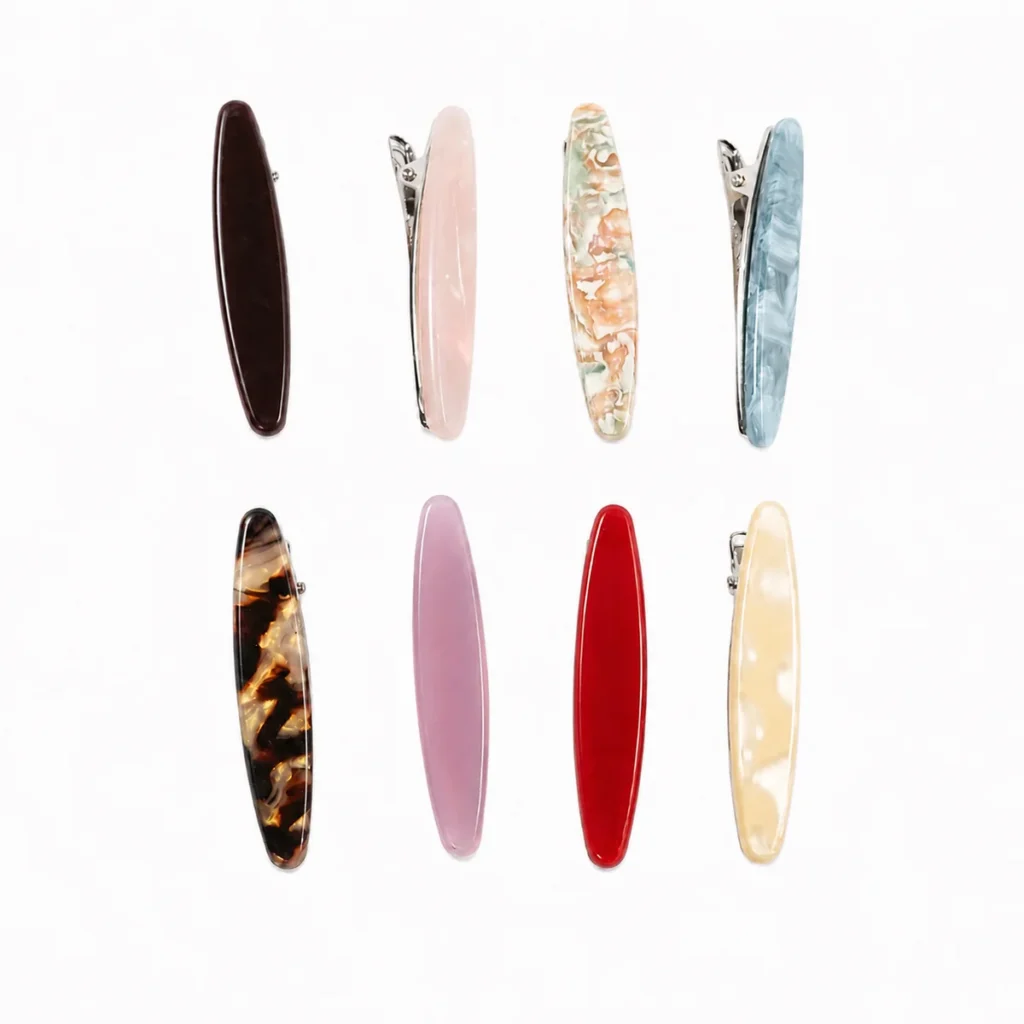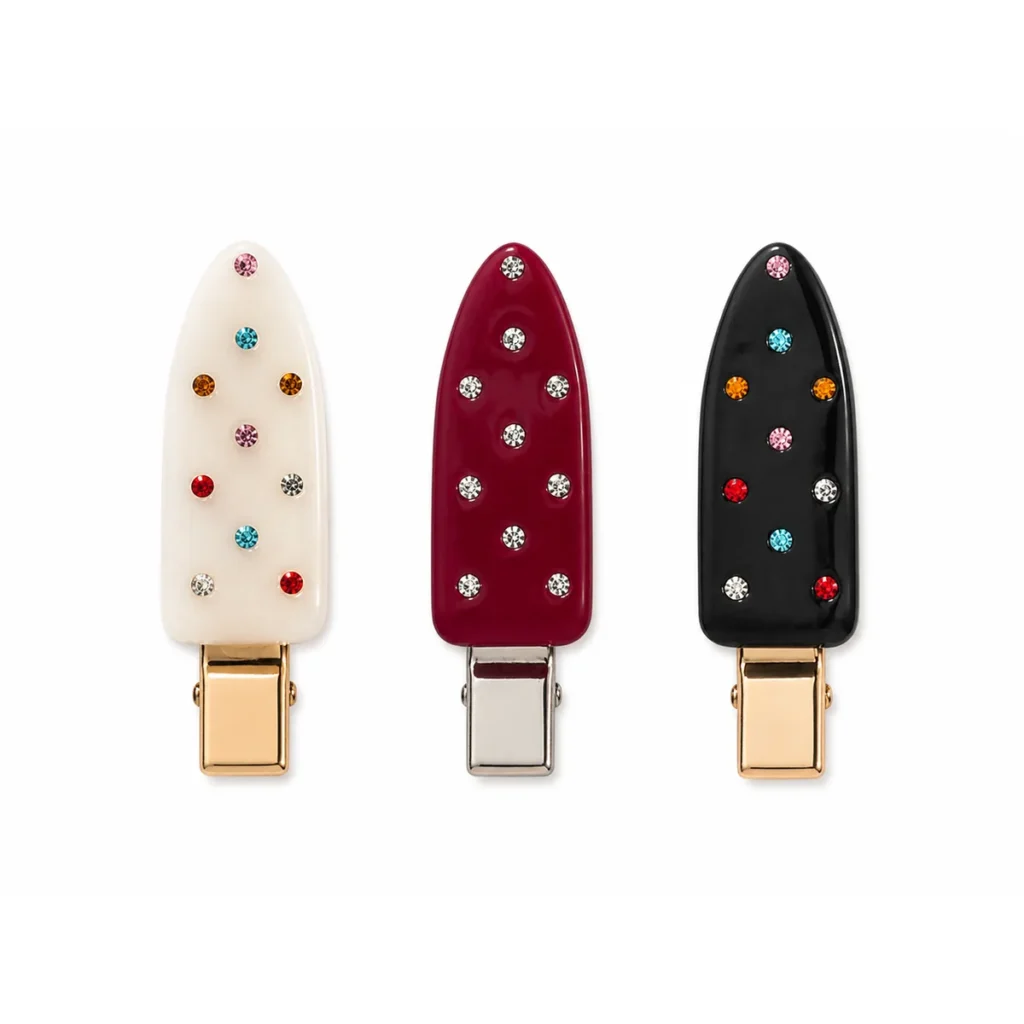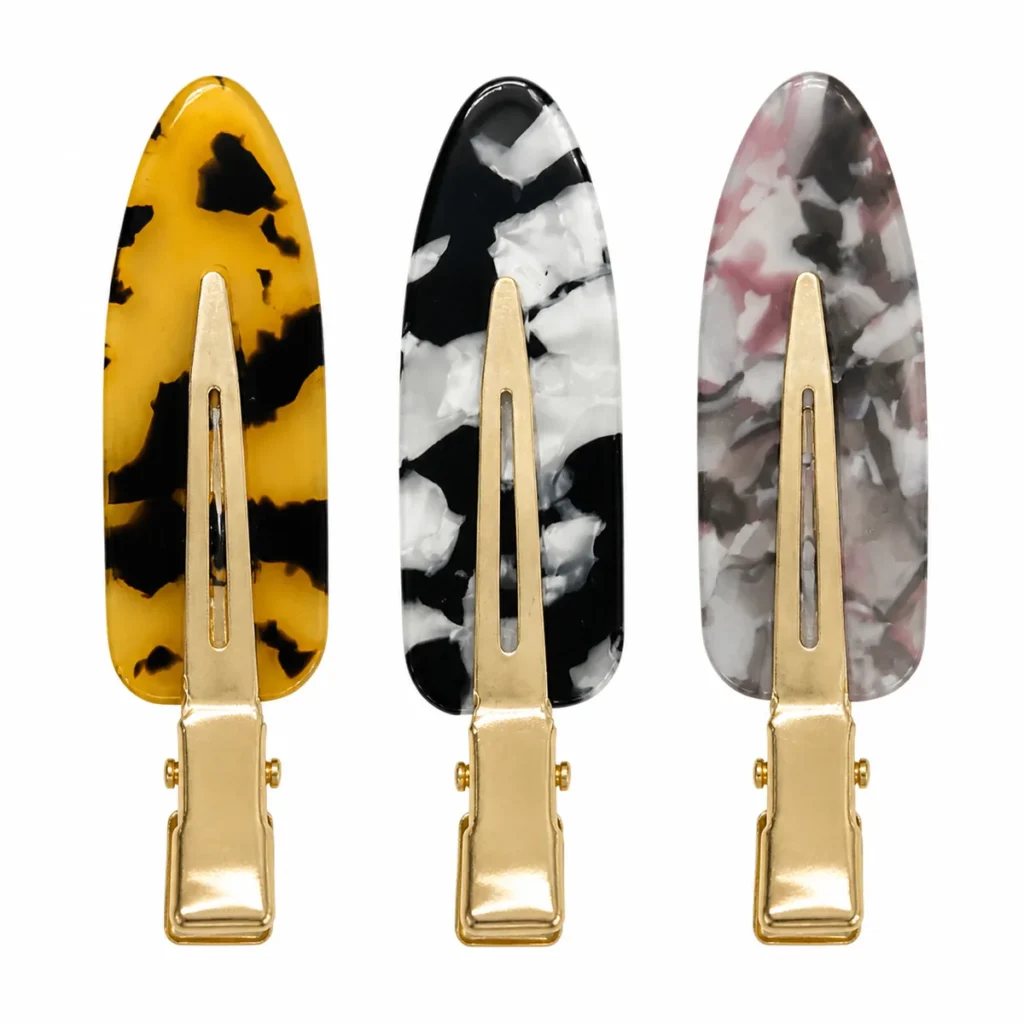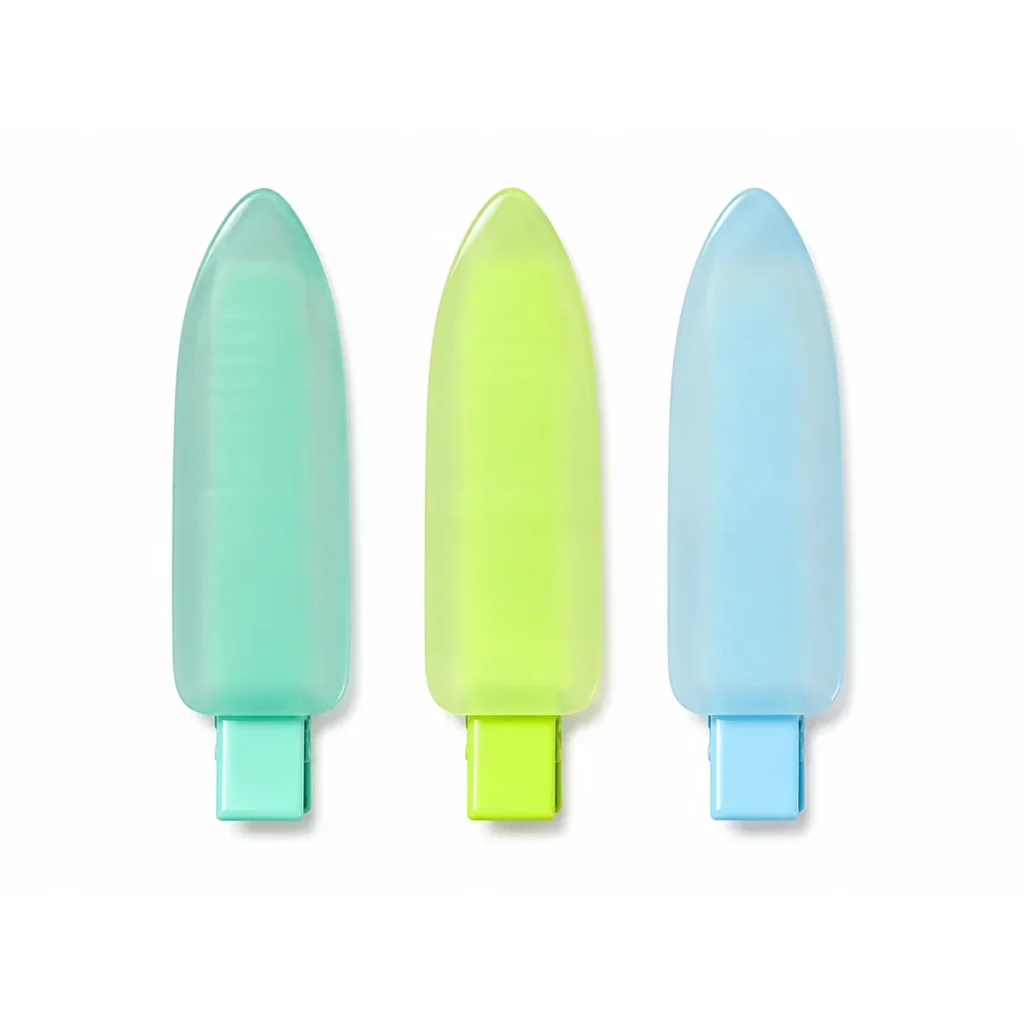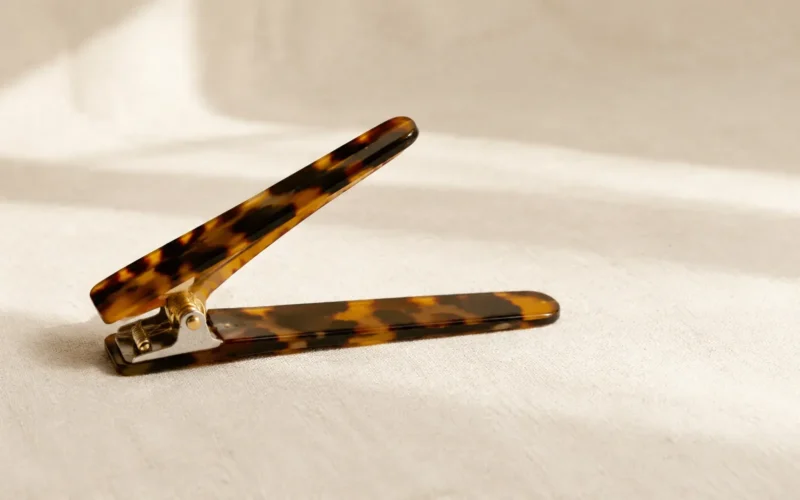
A duckbill clip is the long, flat-jawed clip that almost everyone owns several of and almost nobody can name. It gets called a bill clip, a duck clip, a croc clip, and — most often and most unhelpfully — an alligator clip, which is a different product with different tooling and a different feel in the hand.
If you are sourcing rather than shopping, that naming mess is your first practical problem. Send the word alligator to a factory and there is a fair chance the sample comes back with teeth you did not want, four weeks later. This page sets out what actually distinguishes a duckbill, which parts of it drive the price, the two defects that account for most of the rejections we see, and what a quotation should contain before you compare it against anyone else’s. For how the duckbill sits next to the other six families, start with our guide to the types of hair clips.
What Actually Makes a Clip a Duckbill
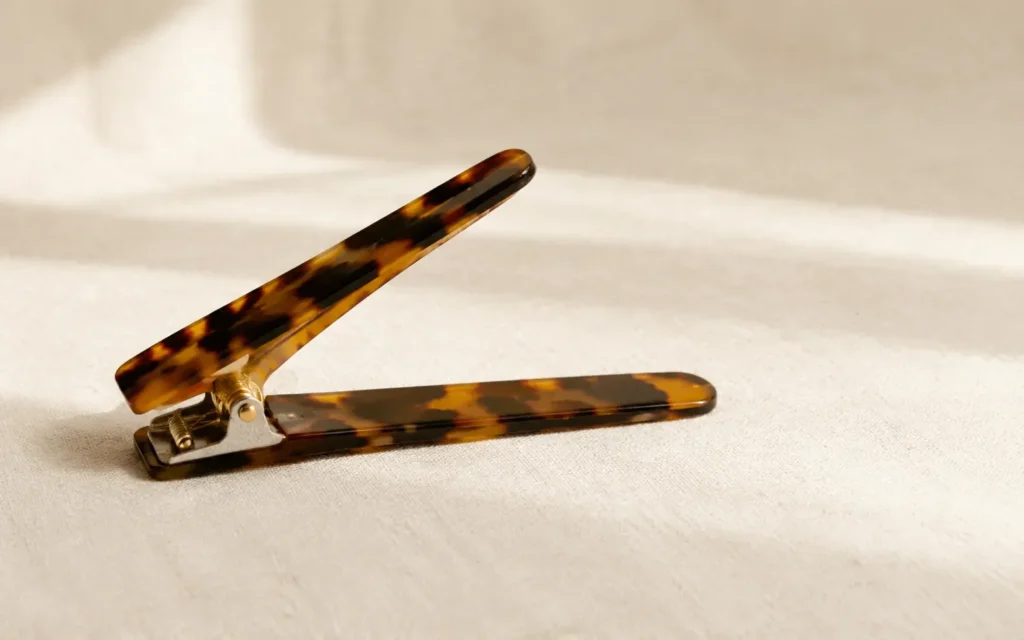
One feature: the jaw. A duckbill has a long, smooth, flat upper jaw that tapers towards a rounded tip — the shape the name comes from. It holds by pressing a section of hair flat along the whole length of that jaw. It does not bite.
That single difference decides everything else. Because the grip is spread over a long contact line rather than concentrated in teeth, a duckbill sits flatter against the head, marks the hair less, and is far more forgiving of fine or fragile hair. It also means the clip is only as good as the spring behind it, because there are no teeth doing any of the work.
Duckbill, Alligator, Snap and Claw Compared
| Duckbill | Alligator | Snap / tic-tac | Claw | |
|---|---|---|---|---|
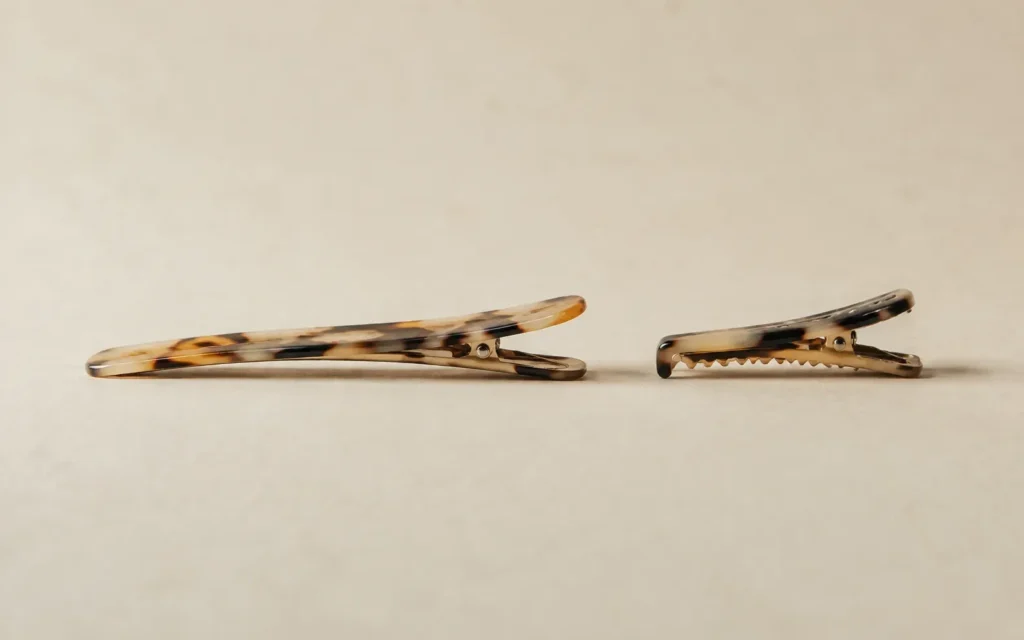
| Jaw | Long, flat, smooth | Shorter, interlocking teeth | One sprung metal strip | Two hinged jaws with prongs |
| Grip comes from | Pressure along the whole jaw | Teeth biting into the section | The snap of the bent strip | Spring tension between prongs |
| Best at | Holding a flat section neatly | Gripping a working section hard | A fringe or a small twist | A whole bun or twist |
| Usually sold as | Finished decorative piece | Salon sectioning tool | Multipack, everyday | Statement piece |
| Metal parts | Spring plus base plate | Spring plus toothed base | The sprung strip itself | Spring bar only |
| Marks fine hair? | Rarely | Often | Rarely | Sometimes at the prong tips |
| Our MOQ in acetate | 500 pcs per design | 500 pcs | 500 pcs | 500 pcs |
The last row is the one buyers are usually surprised by. Because acetate is cut from sheet rather than injection moulded, a new outline costs a cutting profile rather than a steel tool, which is why the minimum sits at 500 pieces instead of the five-figure commitment plastic would need. We set out the full reasoning in why our MOQ is 500 for clips and 1,000 for combs, and the tooling side of it in what mould costs actually cover.
The snap column in that table is the one most often ordered blind: how a snap clip holds, and what to check on the bar goes through that mechanism on its own.
The Part You Are Really Buying Is the Spring
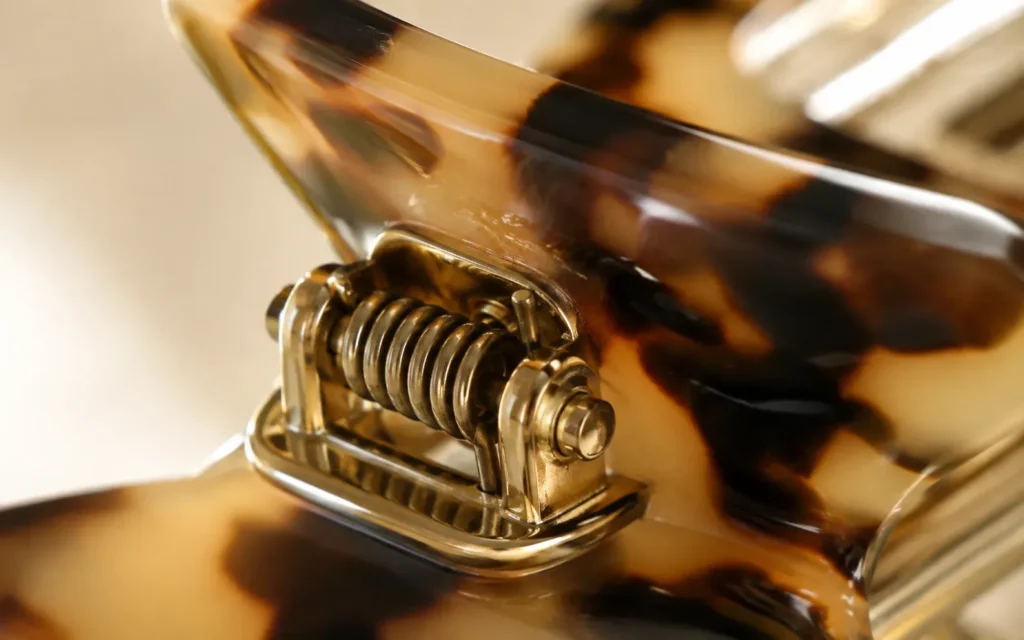
We do not make the springs, and neither does any acetate factory we know of. A clip spring is a stamped, heat-treated metal part produced in the millions by specialists who do nothing else. Buying them in is both cheaper and better than pressing them ourselves, and any supplier telling you otherwise is either vertically integrated in a way that would surprise us or being loose with the word “we”.
Ours cost between RMB 1 and RMB 2 per piece. The whole of that spread is the metal specified.
That one-yuan gap is worth more attention than it usually gets. On a 500-piece trial order it is RMB 500 and nobody notices. On 50,000 pieces it is RMB 50,000, and it is the single line most likely to explain why two quotations for a clip that looks identical in the photographs land a long way apart. So ask what the spring is made of, and ask for the finish separately. A supplier who cannot answer is not buying the part to a specification — they are buying whatever the component shop had that week, which is exactly how a repeat order comes back feeling different from the sample you approved.
Sizes, and Which One Actually Sells
Duckbill clips run from roughly 4.5 cm to 10 cm. Across our own orders, the large sizes outsell the small ones by about seven to three, and 9 cm is the single busiest length.
That ratio catches out brands building a first range. The instinct is to lead with the small decorative sizes because they photograph well and cost less per piece. The volume is at the other end, in the plain large clips that people buy to actually hold their hair up.
| Length | Holds | Typical buyer | Notes |
|---|---|---|---|
| 4.5–6 cm | A fringe or a small twist | Kids’ ranges, multipacks | Rarely sold singly; margin comes from the set |
| 6–7 cm | A half-up section | Everyday accessory brands | Where most decorative work sits |
| 7–8.5 cm | A full side section | Thicker-hair ranges | Needs a longer spring; check the closing force |
| 9 cm | Most of the hair at once | Volume and salon retail | The busiest size we run |
| 10 cm+ | Sectioning during a service | Professional / salon supply | Almost always plain; decoration gets in the way |
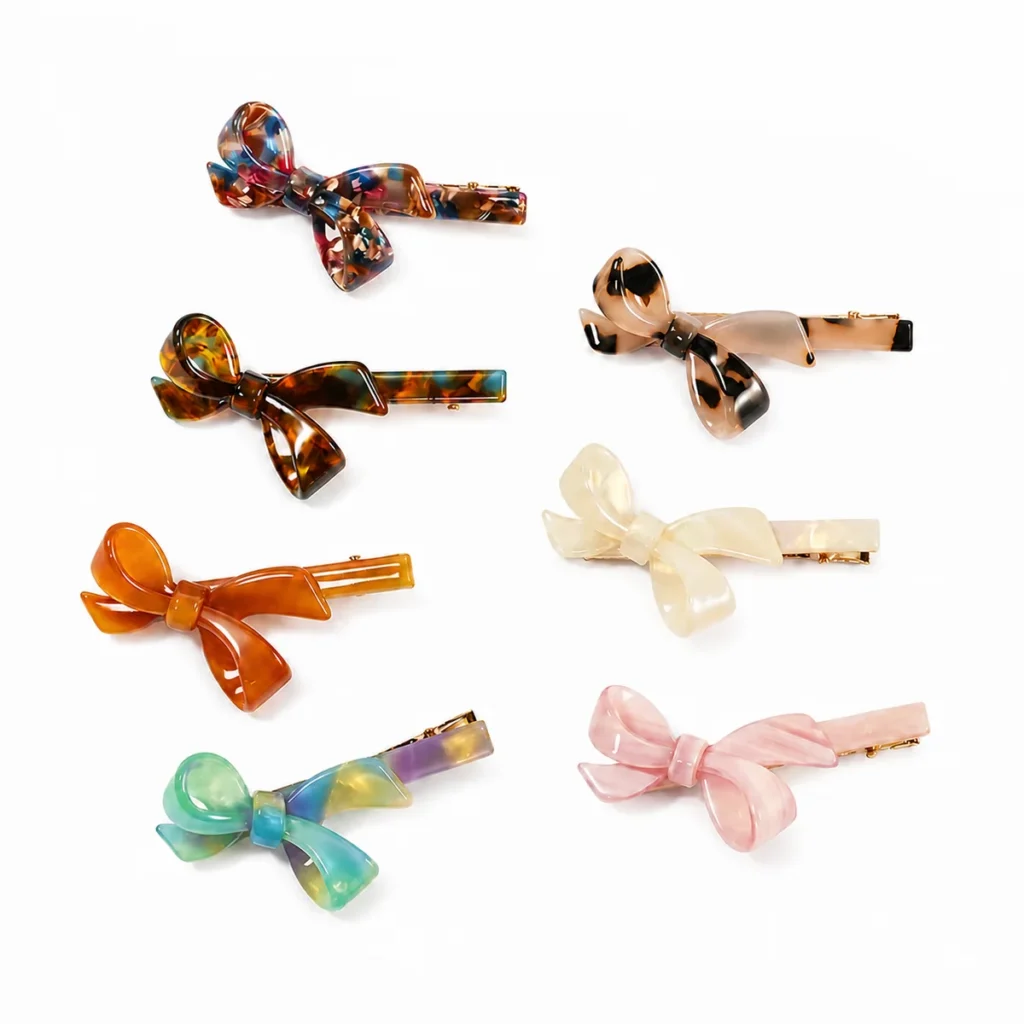
Lengths are measured along the closed clip, tip to hinge. Our published range runs 5.9 cm to 7 cm — the 6.3 cm slim willow, the 5.9 cm crystal-set, the 6.5 cm sculpted bow — because those are the decorative shapes worth photographing individually. The larger plain sizes are quoted to order and carry most of the volume, so if you are planning a range, ask for them explicitly rather than assuming the catalogue is the whole list.
How a Duckbill Clip Gets Made
The body is subtractive from start to finish. Cellulose acetate arrives as pressed sheet with the pattern already inside the material rather than printed on the surface, which is why a tortoiseshell acetate clip still looks tortoiseshell after you file the edge — and why a plastic one does not. That distinction is the whole argument in acetate versus plastic hair clips.
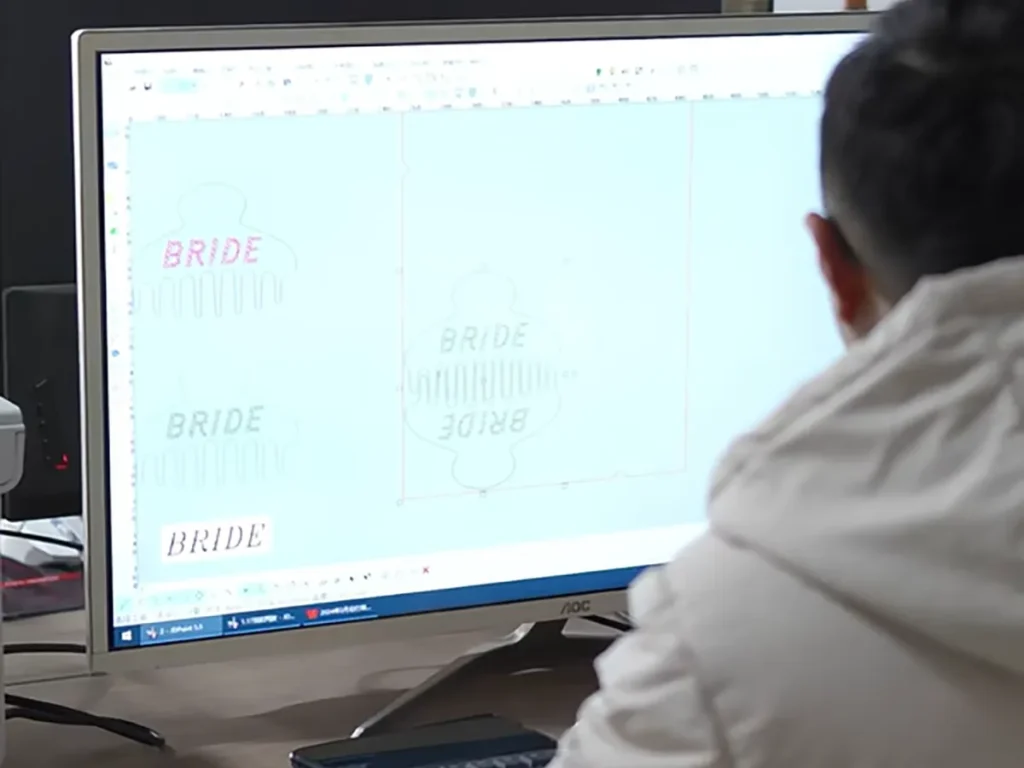
- Blanking. The outline is die-cut or CNC-routed from sheet. How tightly the shapes nest on the sheet decides your material yield, which on a simple clip is a bigger cost lever than labour.
- Shaping. Edges are ground back to profile and the body is heat-set to its curve. A duckbill jaw has to hold a very slight curve or it will not close flush along its length.
- Tumbling and polishing. Hours in rotating barrels with graded media. The gloss on a finished acetate clip is the material itself brought up, not a coating — which is why it does not wear off at the contact points.
- Bonding. The metal base and spring assembly are fixed to the acetate body. This is the step that decides whether the clip is any good.
- Hand finishing and inspection. Deburring, final check, count.
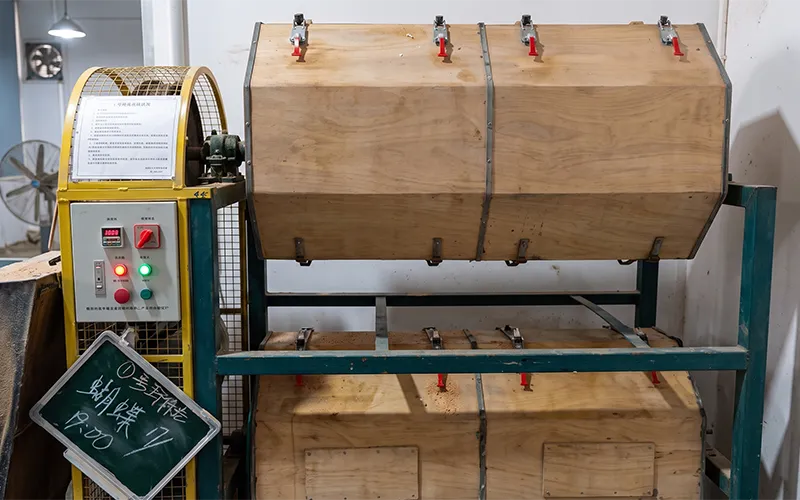
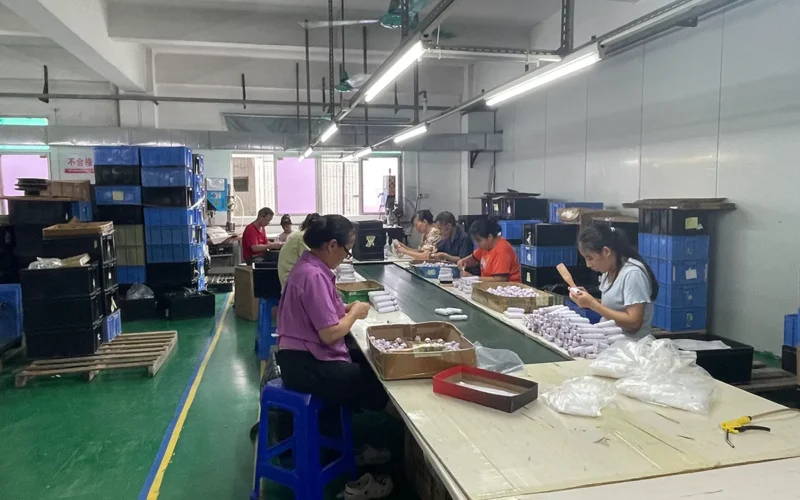
The whole sequence is filmed on our own floor rather than licensed from a stock library. The longer written version is in how acetate hair accessories are made.
The Two Defects That Cause Most Rejections
We are not going to list twenty theoretical failure modes. In practice two problems account for most of what gets pulled at final inspection on duckbill clips, and both of them come from the bonding step.
| Defect | What you see | Where it comes from | How to check a sample in ten seconds |
|---|---|---|---|
| Misaligned jaws | The two halves do not meet flush. A visible gap at the tip, or the clip sits skewed when closed. | The metal base bonded off-square to the acetate body, or the body warped after heat setting. | Close it on a strip of paper and pull. It should resist along the whole jaw, not grip at one end and let go at the other. |
| Loose spring | Opens too easily, or does not return to fully closed. | The spring seated incorrectly at assembly, or under-specified for the jaw length. | Open and release it twenty times. It should come back to the same closed position every time, with the same resistance. |
Longer jaws make both problems worse, which is the hidden cost of the 9 cm size. A 1 mm bonding error at the hinge becomes a visible gap at the tip of a long clip and disappears entirely on a short one. If you are moving a design up in size, re-approve the sample rather than assuming the larger version of an approved clip is also approved.
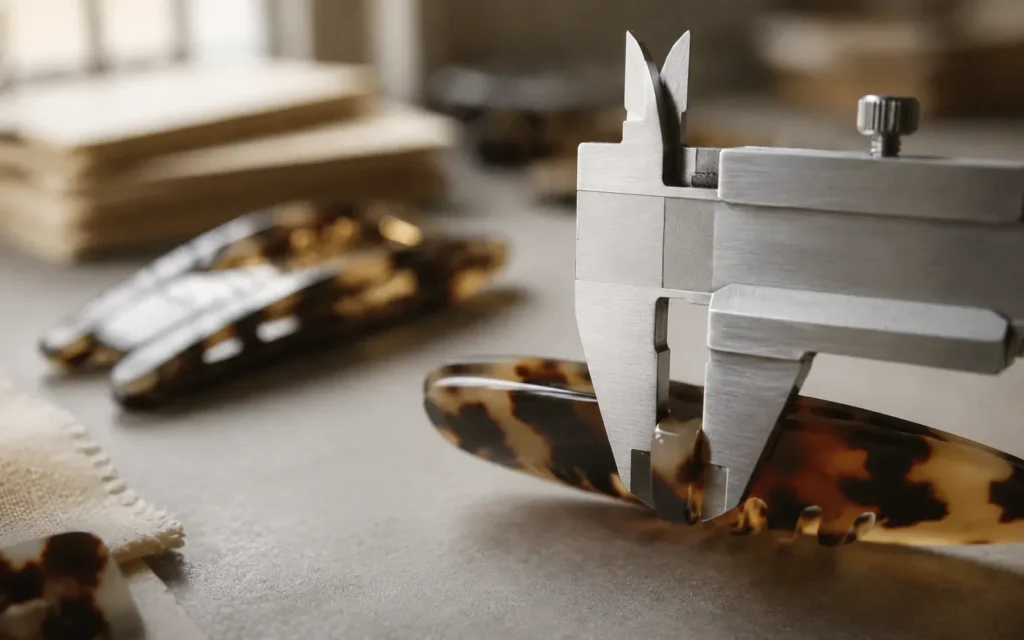
One more thing worth writing into your specification: sheet thickness. Two clips with identical outlines cut from 3 mm and 4 mm sheet feel like different products and cost different amounts, and thickness is the specification most often left off a brief. Our 7 cm thick side clip exists specifically because a buyer asked for the same shape with more substance in the hand.
Designs We Turn Down, and Why
We decline shapes. It is worth saying so plainly, and worth explaining the reasoning, because a supplier who says yes to everything is telling you something about how the third reorder is going to go.
Acetate is cut and ground from sheet. Every internal corner, deep undercut and thin bridge in a drawing has to survive routing, then tumbling, then a spring being fixed to it. Shapes that look fine as a flat vector can come out of the barrel with chipped bridges at a rate that makes the order uneconomic for both of us — and the failures do not show up on the first sample, which is hand-finished. They show up at 5,000 pieces.
So if we say a design needs simplifying, it is not reluctance. It is that we have run the shape and know what the yield does. Where the geometry genuinely has to stay, the honest answer is usually a different material or a different process, and we will say that too.
Colourways and Where the Cost Sits
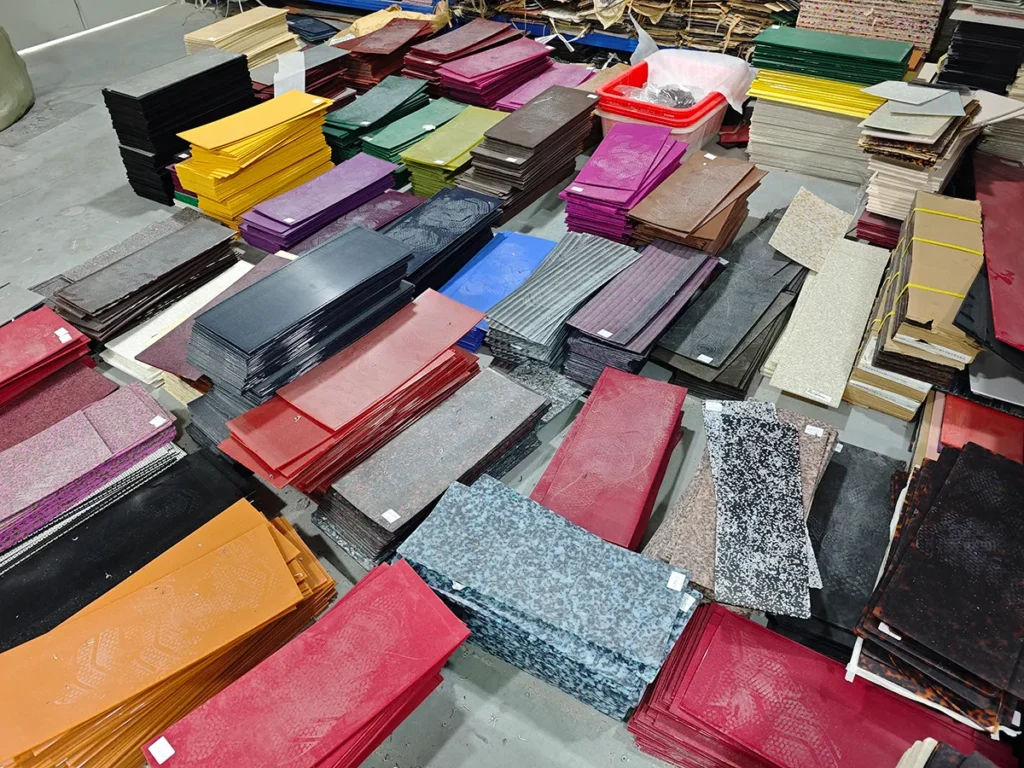
The 500-piece minimum is per design, and a design means one shape at one size. That distinction is worth pressing on, because the two halves of a range behave differently: a second size needs its own cutting profile and its own spring, so it is genuinely a second minimum. A second colour of the same shape runs off the same profile.
So do not assume six colours means six times the minimum, and do not assume it means one either. It depends on which colours and whether they can be scheduled together, which is a question with an actual answer — send the colour list rather than asking in the abstract.
Stock patterns carry no sheet development cost. A bespoke pattern — your own tortoiseshell mix, a specific pearl, a Pantone-matched solid — means a sheet run, and sheet runs have their own minimum that is considerably higher than the clip minimum. For a first order, picking from stock sheet and putting the budget into packaging is almost always the better trade. Our frosted pastel duckbill and the tortoiseshell duckbill on a gold base both run on stock patterns.
Before You Import Them
Three things sit outside what a factory can decide for you, and all three are cheaper to settle before production than after.
- Tariff classification. Hair slides and clips generally fall under heading 9615, with the split below that turning on the material of the body. Cellulose acetate and wood do not land in the same place. Confirm the line with your broker against the current US Harmonized Tariff Schedule rather than reusing a code from a previous shipment of something else.
- Children’s ranges. If the clip is marketed to children, a different set of US rules applies to it than to the identical clip sold to adults — testing, tracking labels, and a certificate. Start at the CPSC, and tell your supplier at the briefing stage rather than after the sample is approved, because it changes the components we can use.
- California. If any of your volume ships into California, read our note on Prop 65 and hair accessories first, then the official list at OEHHA. The metal base is the part that matters here, not the acetate.
What to Send Us for a Real Quotation
A photograph gets you a number that will be revised later. These five lines get you one that will hold.
| Tell us | Why it changes the price |
|---|---|
| Jaw length, in mm | Sets the spring size and the material per piece |
| Sheet thickness | The most commonly omitted spec; changes both cost and feel |
| Sizes and colourways, and how many of each | Each size carries its own minimum; colours of one shape may share it |
| Stock pattern or bespoke sheet | Bespoke means a sheet run with its own minimum |
| Any decoration, and whether it is set or bonded | Hand-set stones are a labour line, not a material line |
Timing: budget around nine weeks from approved sample to goods on the water for a first order, and understand where that time actually goes before you commit to a launch date — we have broken it down in where the 62 days go. What the sampling stage costs and what to check before signing it off is in sampling costs and approval.
If you are still deciding between clip types, the French barrette covers the hinged-bar alternative. How the minimums compound once you add sizes and colours is in wholesale hair barrettes. The full range sits under hair clips and barrettes.
Duckbill Clips We Make