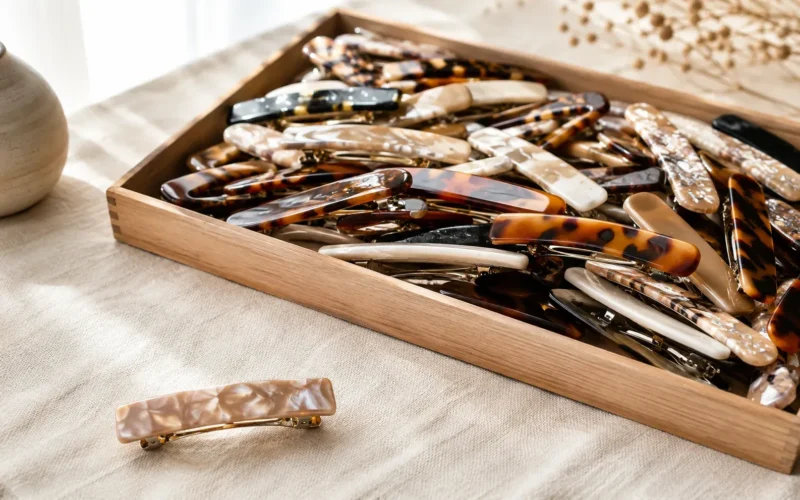
Barrette pricing looks simple until you ask two suppliers for the same thing and the numbers come back forty per cent apart. Neither of them is lying. They are quoting different products, because a barrette is an assembly of a body, a clasp and a finish, and the brief you sent probably only specified one of the three.
If you are planning more than one clip and barrette for a shelf rather than buying a single style, use our retail-ready wholesale hair clips range guide to decide which SKU roles should carry the first order.
This page is about the other two. What a barrette actually consists of, which specifications move the unit price and by how much, how the minimum order quantity compounds once you add colours, and the questions that separate a quotation you can plan around from one that gets revised after you have committed to a launch date.

First, Agree What You Are Buying
“Barrette” is American. In the UK the same object is a hair slide, and in a supplier’s inbox both words cover at least four mechanisms that cost different amounts to make. Before anything else is discussed, settle which clasp you mean — it is the single biggest source of mismatched quotations we see.
| Type | Mechanism | Holds | Cost driver | Best for |
|---|---|---|---|---|
| French barrette | Hinged bar under tension, clicks into a catch | A thick section, very securely | The bar and catch assembly | Everyday wear, thicker hair |
| Duckbill / bill clip | Sprung jaws, long flat upper jaw | A flat section against the head | The bought-in spring | Fine hair, decorative pieces |
| Snap / tic-tac | A single bent metal strip that snaps | A fringe or small twist | Almost nothing — cheapest clasp | Multipacks, kids’ ranges |
| Automatic / spring bar | Sprung bar, opens by pressing the ends | A medium section | The bar, plus assembly labour | Salon retail |

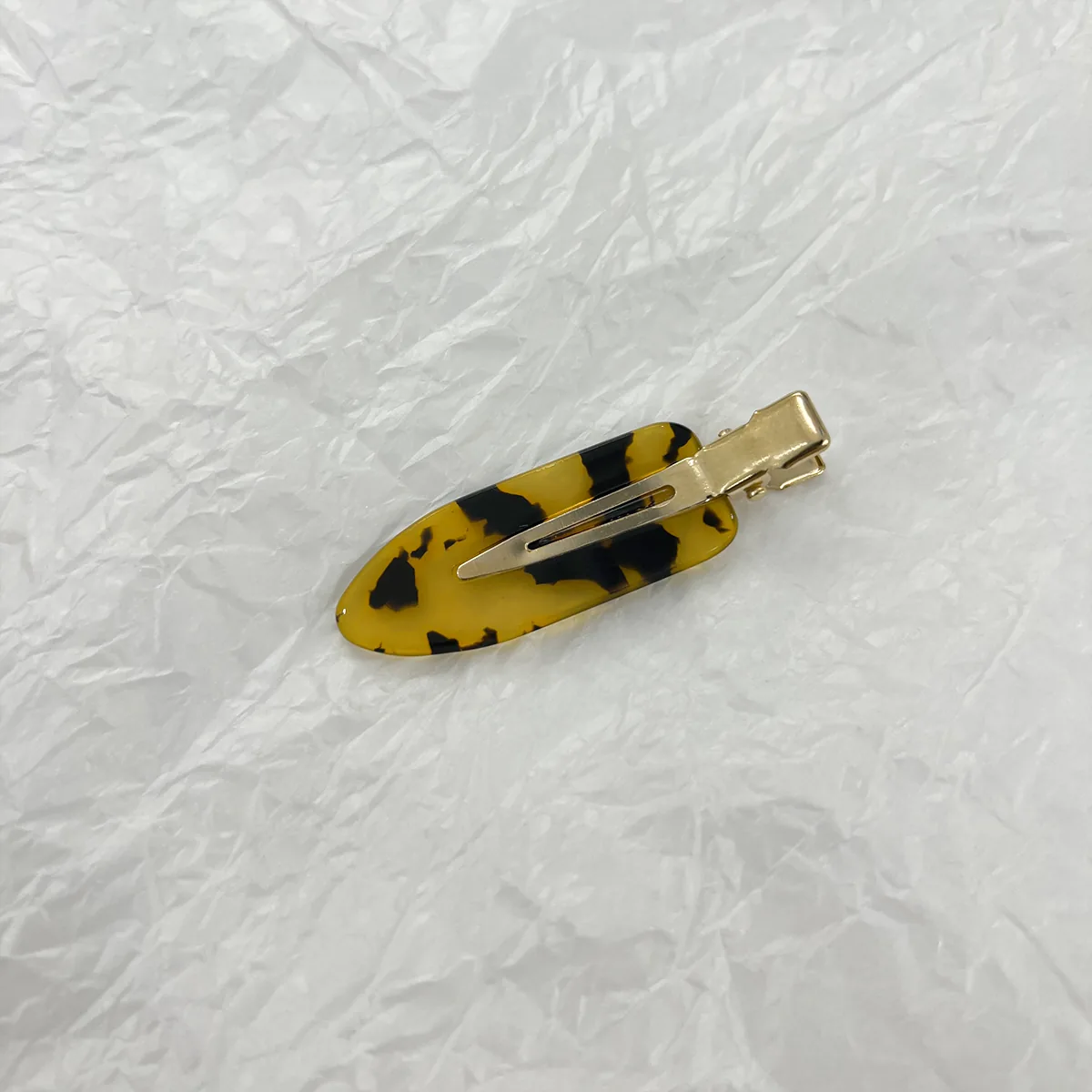
If you want the mechanism explained properly rather than tabulated, we wrote a separate piece on what a French barrette is. The sprung-jaw family is covered separately in duckbill clips. To see every family at once before you narrow down, read types of hair clips.
Sizes, and How Many You Actually Need

A first range usually wants three lengths and ends up ordering five. Three is almost always right.
| Length | Holds | Where it sells | Notes |
|---|---|---|---|
| 5–6 cm | A small twist, a fringe | Multipacks and sets | Rarely carries a price on its own |
| 7–8 cm | A half-up section | The everyday size | Where most decorative work goes |
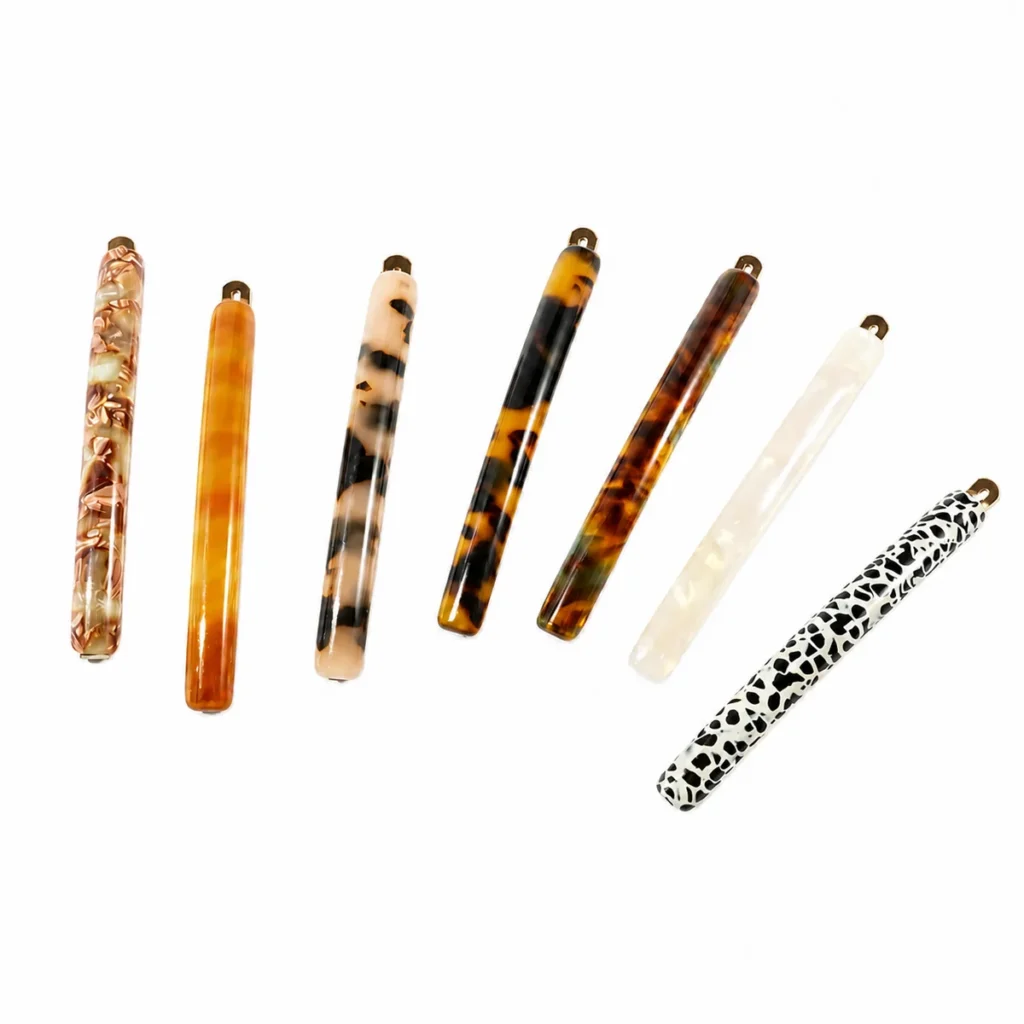
| 9 cm | A full ponytail or thick section | The volume length | Our 9 cm tortoiseshell bar sits here |
| 10–11 cm | Most of the hair | Thick-hair and specialist ranges | Needs a heavier clasp; check the closing force |
| 12 cm+ | All of it | Niche | Hard to keep flat against the head |
Lengths are measured along the finished piece, end to end. The trap is that each length is a separate design for minimum-order purposes, because each needs its own cutting profile and its own clasp size. Three lengths is three minimums before a single colour has been chosen, and that is the most common reason a first order comes in over the budget the brand had in mind. Colours may or may not multiply on top of it — see the next section — but sizes always do.
How the Minimum Actually Works
Our minimum on acetate clips and barrettes is 500 pieces per design — one shape at one size. The reasoning, and why combs sit at 1,000 while clips sit at 500, is in MOQ explained. The part that matters when you are planning a range is that sizes and colours do not behave the same way.
A second size is a second cutting profile and a second clasp, so it is a second minimum, reliably. A second colour of the same shape is not necessarily anything of the kind — several colourways of one profile can often be scheduled together. Sizes multiply for certain. Colours are the negotiable half, and the only way to find out by how much is to send the actual list.
| Your range | Separate designs | Pieces if colours run separately | Comment |
|---|---|---|---|
| 1 size, 2 colours | 1 | 1,000 | A sensible first order |
| 1 size, 6 colours | 1 | up to 3,000 | Most room to negotiate — one profile, six colours |
| 3 sizes, 4 colours | 3 | up to 6,000 | Where a first budget usually gets its surprise |
| 3 sizes, 2 colours | 3 | up to 3,000 | Same spend, far better information |
The middle column above is fixed; the third is a ceiling rather than a quote, so ask with your colour list in hand. Our advice for a first order is consistently the fourth row: go wide on size and narrow on colour. Sizes tell you about your customer’s hair, which does not change. Colours tell you about a season, which does. You can add colourways on the reorder in eight weeks once the sell-through data exists; adding a size later means a new cutting profile and a new clasp, which is slower.
What Moves the Unit Price
Five things, in roughly the order they matter on a typical acetate barrette.
- Material yield. How tightly the shapes nest on the sheet. On a plain barrette this is a bigger lever than labour, and it is entirely a function of the outline you drew. A long thin bar nests beautifully. A wide asymmetric shape wastes sheet, and you pay for the sheet, not for the piece.
- Sheet thickness. The specification buyers most often leave out. Three millimetres and four millimetres produce clips that feel like different products and cost meaningfully different amounts.
- The clasp. Bought in, not made here. Our clip springs run RMB 1 to RMB 2 per piece and the entire spread is the metal specified. At 500 pieces that gap is invisible. At 50,000 it is RMB 50,000, and it is usually the hidden difference between two quotations.
- Decoration. Hand-set stones and applied pearls are a labour line, not a material line, and they scale linearly — there is no volume discount on a person’s time in the way there is on sheet.
- Sheet origin. Stock pattern or a run made for you. Bespoke sheet carries its own minimum, considerably above the barrette minimum.
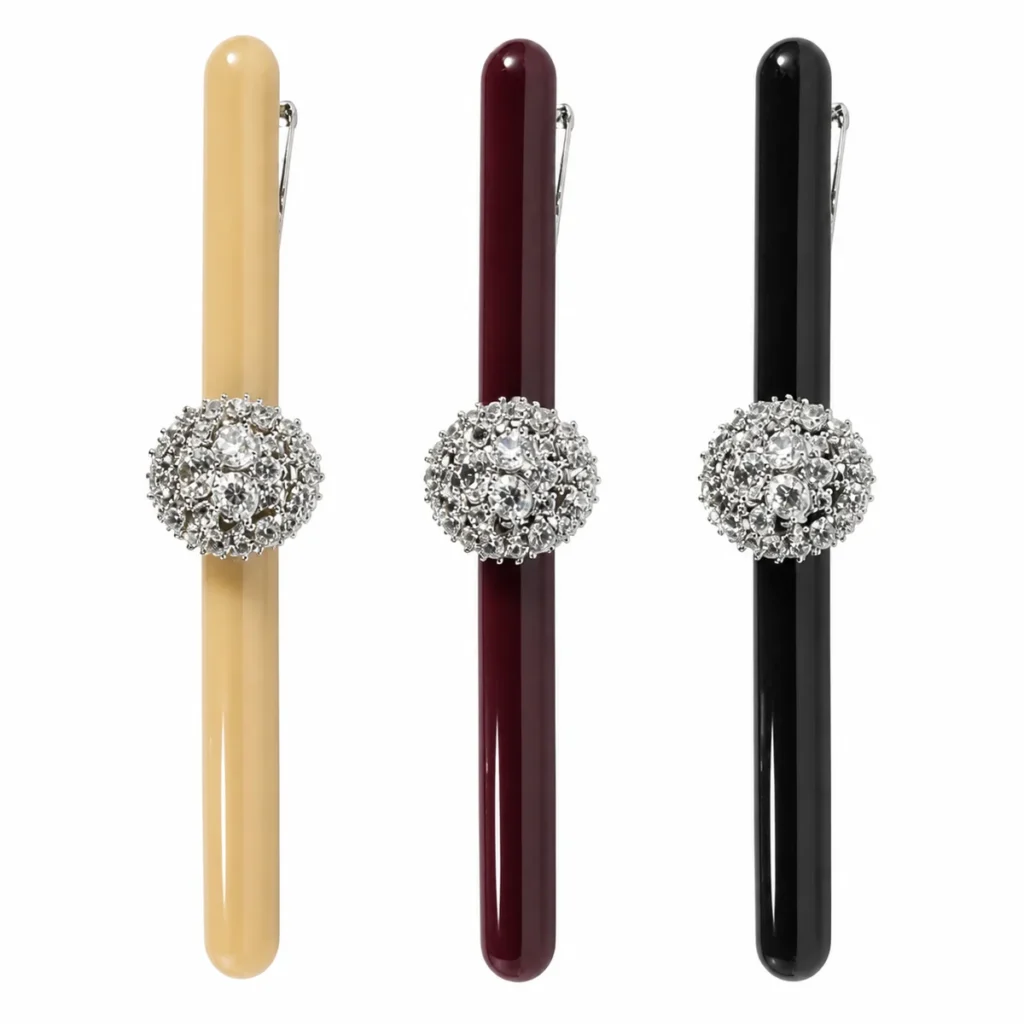
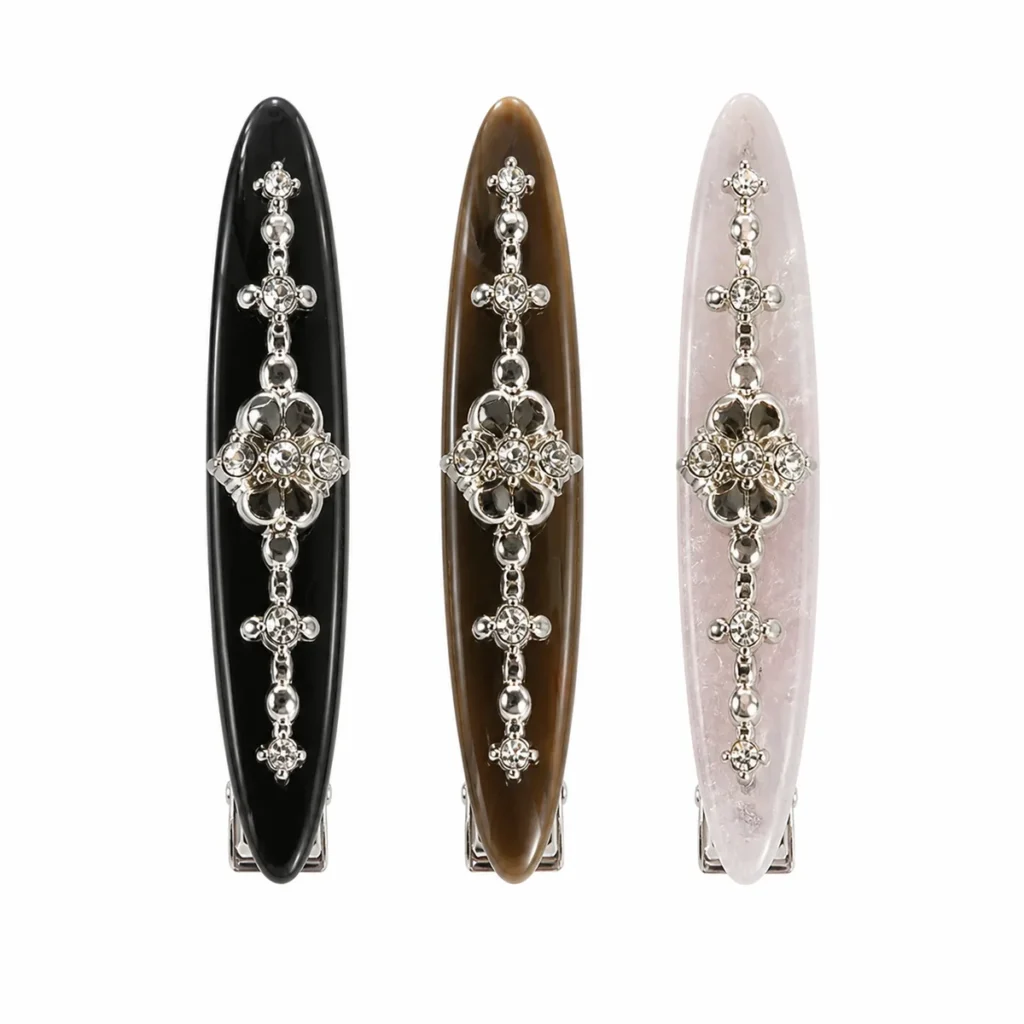
Point four is worth an illustration, because “hand-set” gets used loosely. On our pavé crystal bar barrette and willow-leaf crystal barrette — both in the range at the foot of this page — every stone is placed by a person. That is the cost, and it is also why the finish holds up — a bonded scatter applied in one pass is cheaper and comes off in the bottom of a handbag.
Colour: Stock Sheet or Your Own
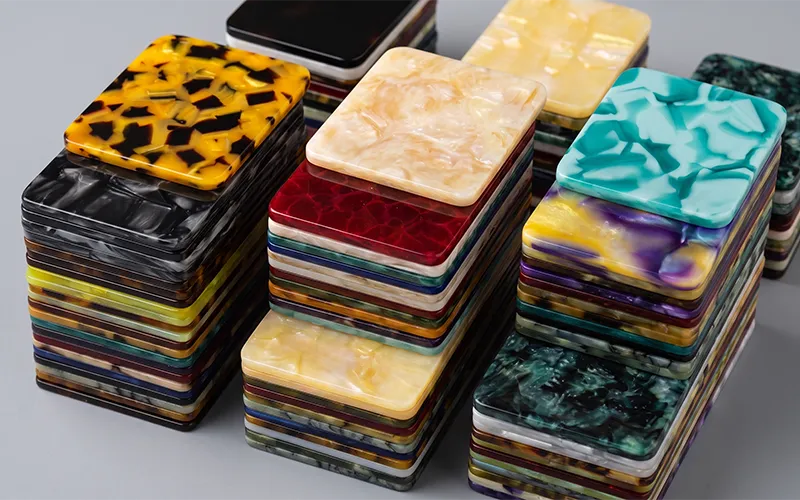
Acetate patterns are inside the material, not printed on it. A tortoiseshell sheet is tortoiseshell all the way through, which is why the edge of a finished barrette still shows the pattern and why the gloss does not wear away at the contact points. It is also why colour matching works differently here than it does with sprayed plastic: you are not matching a coating, you are selecting or commissioning a sheet.
For a first order, take stock. There are enough patterns on that board to build a coherent range, they carry no development cost, and they do not add weeks. Put the difference into packaging, which is where a shopper actually forms a price impression. Commission your own sheet on the reorder, when you know which two colours earned it. The deeper argument for the material itself is in acetate versus plastic.
Putting Your Name On Them
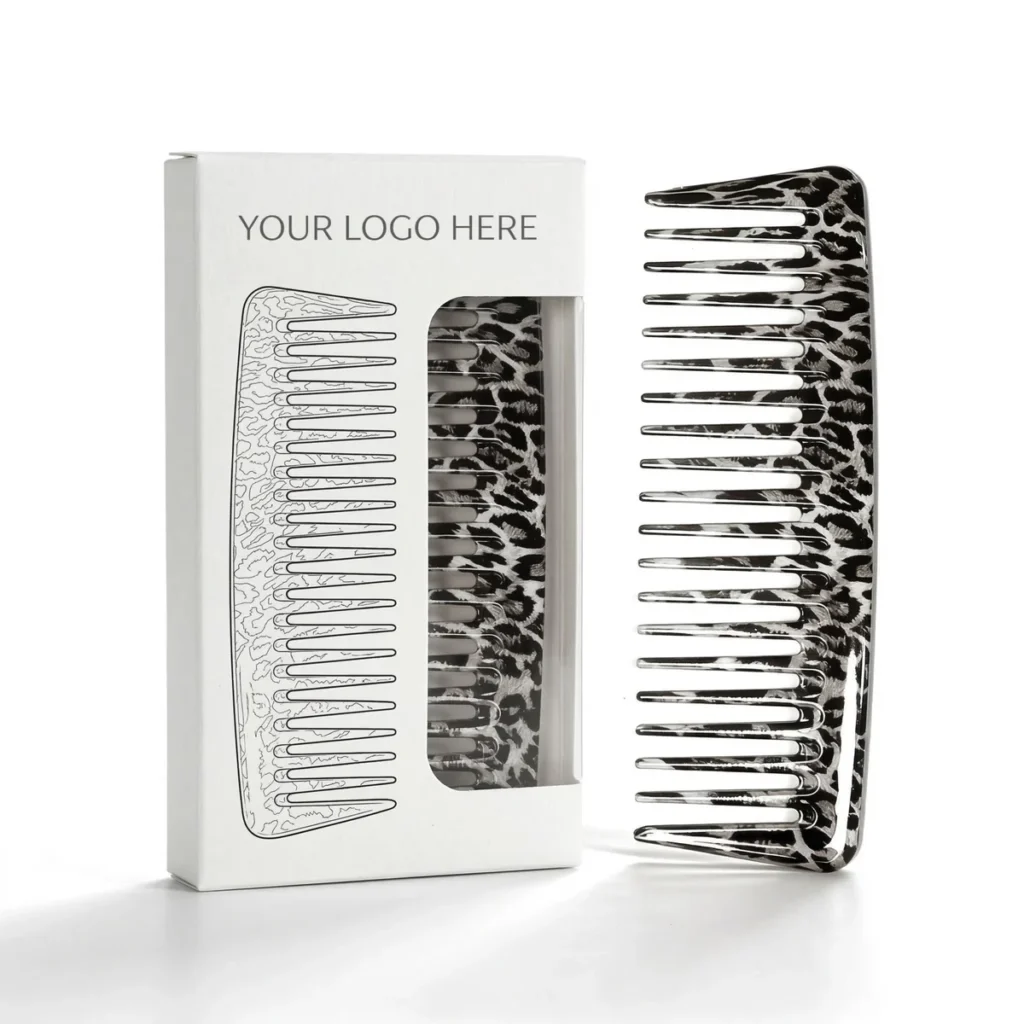
Three places your brand can go, in increasing order of cost and commitment:
| Where | Method | Cost | Changeable between orders? |
|---|---|---|---|
| Card, sleeve, box | Lowest — it is a print job | Freely | |
| On the metal clasp | Pad print or laser | Low, per piece | Yes, with notice |
| On the acetate body | Pad print | Low per piece, needs a flat area | Yes |
What you own at the end of this — the artwork, the pattern, the shape — depends on how the arrangement is written, not on how much you spent. Private label versus OEM covers what each one actually gives you, and it is worth reading before the first deposit rather than before the third reorder.
What Goes Wrong on a Barrette
Barrettes fail at the clasp. The acetate body is a solid piece of material that has been ground and polished — there is very little that can go wrong with it that you will not see immediately. The mechanism is an assembly, and assemblies are where defects live.
All four of the checks below work on a single sample, on a desk, in under a minute. Do them before you approve, and do them again on the first production shipment rather than only on the sample — the sample was hand-finished by one person who cared about it.
| What goes wrong | How it shows | Where it comes from | Your check |
|---|---|---|---|
| The catch does not seat | Clicks home some of the time, springs open the rest | Catch bent out of alignment at assembly, or bar tension wrong for the length | Close and open it twenty times. You want the same click every time, not nineteen out of twenty. |
| The bar loses tension | Holds when new, slides out after an hour of wear | Bar under-specified for the section size the length implies | Clip it onto a bundle as thick as your intended section and leave it. Come back in an hour. |
| Play at the hinge | The bar wobbles sideways; the barrette sits crooked | Rivet under-peened at assembly | Hold the body, waggle the bar sideways. There should be no lateral movement at all. |
| Sharp edge underneath | Catches hair; occasionally scratches | Deburring missed where acetate meets metal | Run a fingernail along the underside edge and around the clasp seat. |
The longer the barrette, the harder all four get. A small alignment error at the hinge becomes a visible gap at the far end of a 10 cm bar and vanishes entirely on a 6 cm one. So if you scale an approved design up a size, re-approve it. The larger version of an approved barrette is not an approved barrette, and this is the single most common way a range that sampled beautifully arrives disappointing.
Getting the Same Thing Again Next Year
Repeatability is the part of wholesale that nobody discusses at the quotation stage and everybody discovers at the reorder. Three things make it work, and all three cost nothing if you do them at the start.
- Keep a sealed reference sample. Not the one in the showroom that people have been handling — a sealed one, dated, that nobody opens except to settle an argument. Ask your supplier to keep a matching one.
- Record the sheet, not the colour name. “Tortoiseshell” is not a specification; there are dozens. Get the supplier’s sheet reference in writing and quote it back on the reorder.
- Get the clasp specification in writing, once. This is the component most likely to change quietly between runs, because it is bought in rather than made. A written spec turns a substitution into something you can point at.
Acetate helps here in a way plastic does not. Because the pattern is in the material rather than sprayed onto it, a repeat run from the same sheet reference matches — there is no coating batch to drift. What varies between sheet runs is the pattern itself, which is exactly why the reference number matters more than the name.
Timing, and Where It Goes

Budget around nine weeks from approved sample to goods on the water for a first order. The part that surprises people is the distribution: production itself is a minority of it, and sampling plus approval rounds are the majority. We counted it properly in where the 62 days actually go.
The single most effective thing you can do to compress that number is to make your first sample brief complete, because each incomplete round costs a week and a shipping leg. What a sample should cost and what to check before approving it is in sampling costs and approval.
One logistics note that catches first-time importers: hair accessories are light and bulky once each piece is sleeved and carded. Air freight is charged on volumetric weight, so packaging decisions made for the shelf can double a freight bill. Settle the retail packaging before you quote the freight, not after.
Compliance, Briefly
- Classification. Hair slides and clips generally fall under heading 9615, with the split below that turning on the material of the body — acetate and wood do not land in the same line. Check the current Harmonized Tariff Schedule with your broker rather than copying a code from an unrelated shipment.
- Selling into the EU. The metal clasp, not the acetate, is the part that attracts attention — nickel release in particular. Start from the ECHA REACH pages and tell your supplier which market the goods are for at the briefing stage, because it changes the components we specify.
- Wood versions. If any part of the range is wood or bamboo rather than acetate and you intend to make a claim about it, the claim needs a chain-of-custody behind it. FSC is the usual route. Do not put a certification logo on a card you cannot substantiate.
Five Questions Worth Asking Before You Compare Quotations
- What thickness of sheet is this quoted on? If it is not stated, it is not quoted. This is the most common reason a cheaper number is not actually cheaper.
- What is the clasp made of, and what is the finish? A supplier who cannot answer is not buying the part to a specification, which means the reorder can differ from the sample.
- Is the MOQ per colourway, per size, or per order? Get the answer in the same units you plan your range in, or the arithmetic in the table above will surprise you.
- Is the pattern stock sheet or a run made for me — and if it is stock, can it be repeated in a year? Stock does not always mean permanent.
- Who makes the clasp, and who assembles it? The answer tells you whether you are talking to a factory or a coordinator. How to tell a factory from a trading company has four more tests like this one.
Where to Start
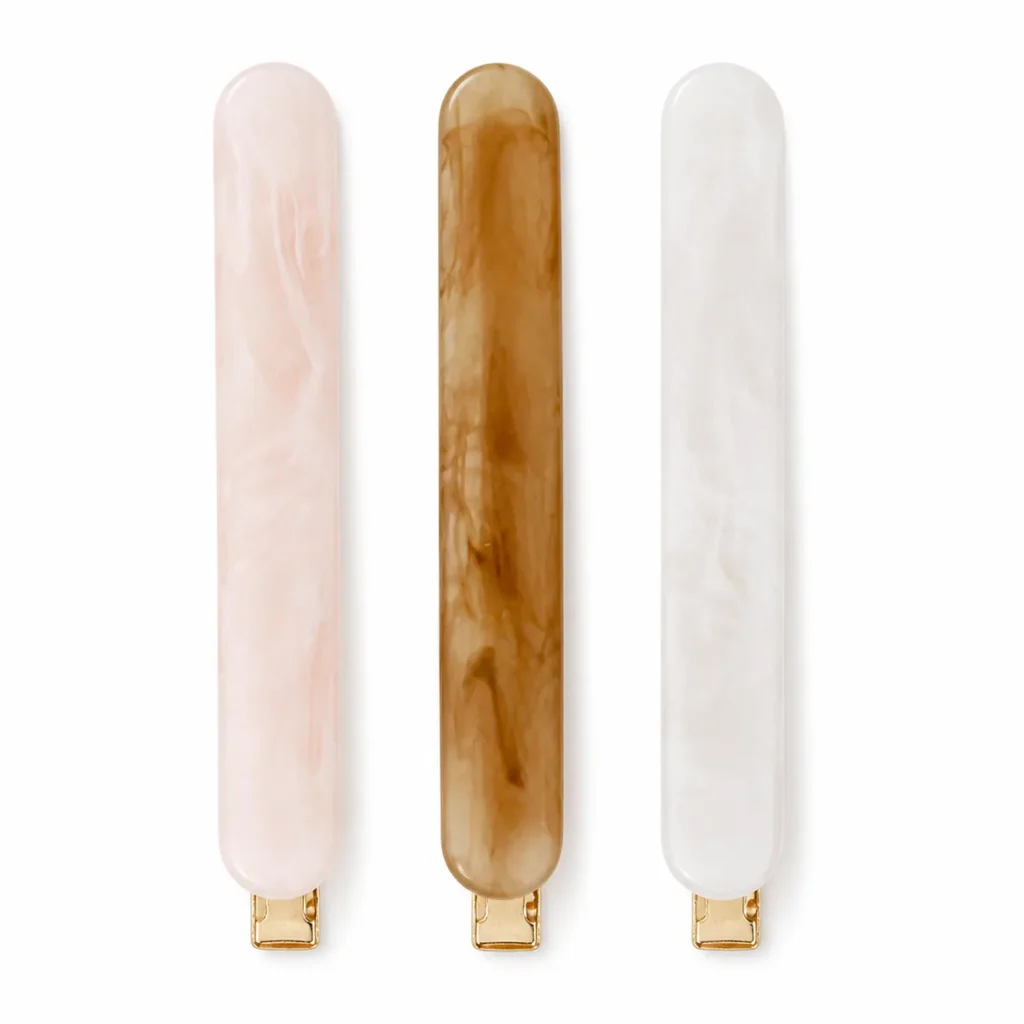
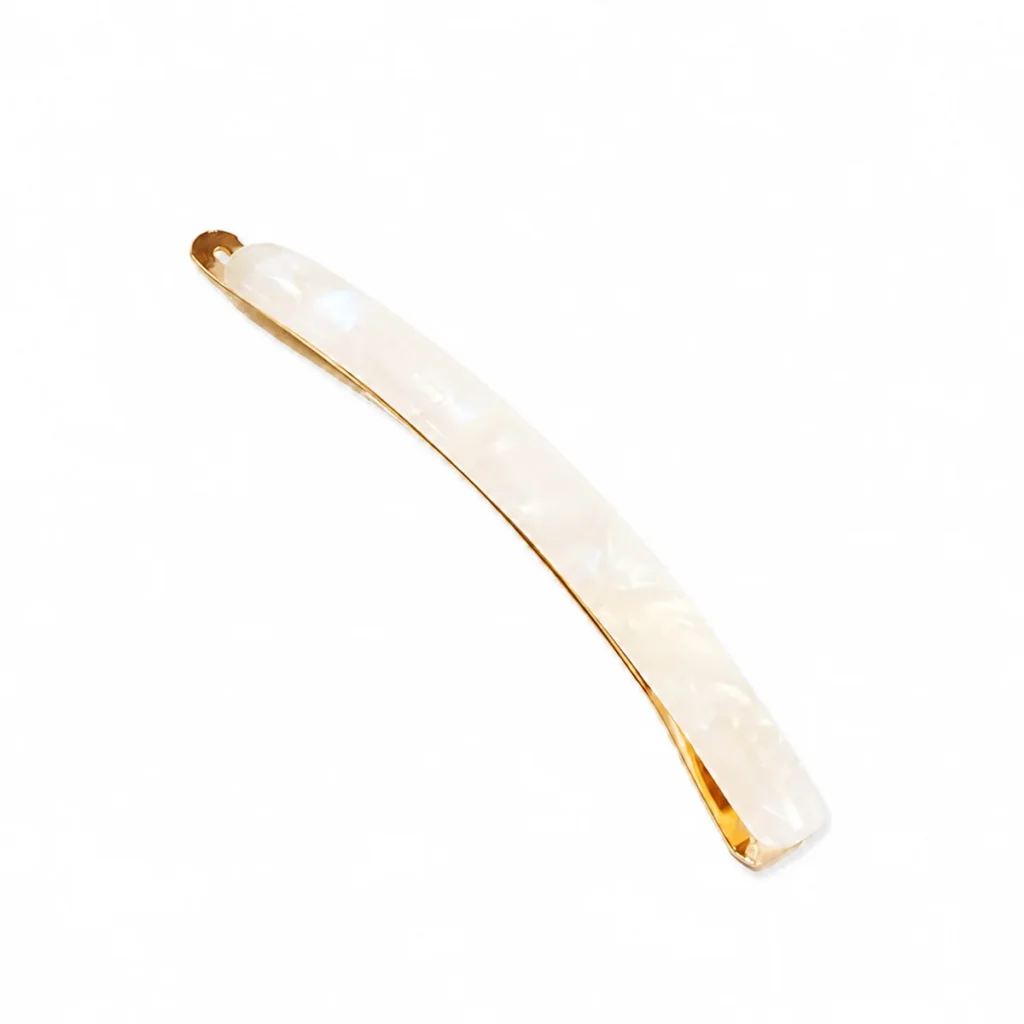
If you have a design, send the outline, the thickness, the lengths and the colour count, and you will get a number that holds. If you do not, the faster route is to start from something that already runs — the acetate French barrette in oval and bar profiles, the 9 cm tortoiseshell bar, or the pearl barrette — and change the sheet rather than the shape. A stock shape in your own colourway is the cheapest way to get a range on a shelf, and it costs nothing in tooling or lead time.
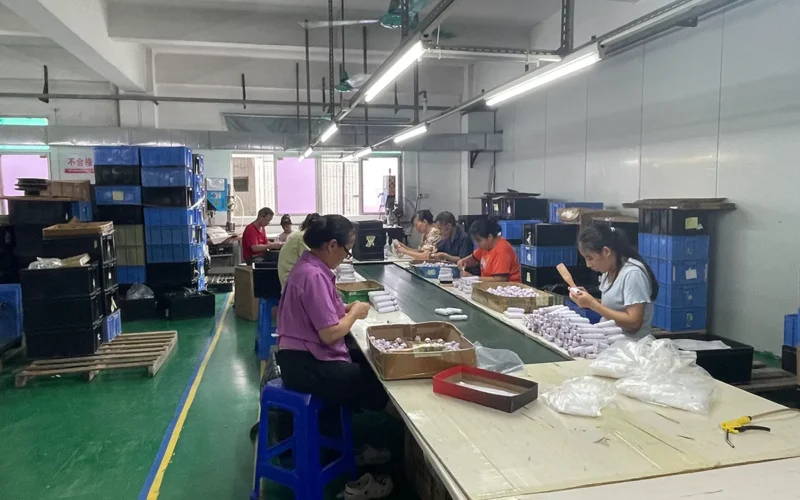
The full range is under hair clips and barrettes. If you are earlier than that and still choosing a supplier at all, how to source hair accessories from China is the place to start. Every process named on this page is filmed on our own floor.
Barrettes We Make